
Method validation uses experimental evidence and records to show that an analytical procedure is fit for its intended purpose. One good result is insufficient. First define the sample, analyte, concentration range, preparation and instrument conditions; then test whether the complete procedure delivers the performance needed for the decision.
This introduction follows four questions: What is the method for? Which performance characteristics matter? What evidence should be recorded? How is performance maintained in routine work? Inductively coupled plasma mass spectrometry (ICP-MS) provides the running example. Separate guides explain trueness, precision, specificity and quantitation limits in more detail.
↔ 表が見切れている場合は、左右にスクロールしてご覧ください。↔ Scroll the table horizontally to see any hidden columns.
| First question | Short answer |
|---|---|
| Why validate? | To show with data whether a result can support the decision it is intended to inform |
| What is tested? | Whether the required trueness, precision, specificity, quantitation limit and other characteristics are achieved for the stated samples, analytes and range |
| When? | When developing a method, expanding its scope or making a change that can affect results, among other occasions |
| What is recorded? | Intended use, criteria set in advance, study plan, raw data, decisions and scope of application |
The purpose: show that the method fits its intended use
Analytical results can determine whether incoming material is accepted, a product is released or an environmental limit is met. The method must have adequate performance for the sample and concentration range relevant to that decision.
For example, an ICP-MS procedure that measures trace elements in water cannot automatically be transferred to a high-salt process liquid. Matrix-related signal suppression, polyatomic-ion interferences, contamination from vessels or reagents, and losses during preparation can change the result.
Validation should make it possible to answer:
- What analyte is measured, in which samples and over which concentration range?
- How are components and operations that can affect the result controlled?
- Which experiments and records demonstrate the required performance?
- Where does the demonstrated scope of the method end?
The International Council for Harmonisation of Technical Requirements for Pharmaceuticals for Human Use (ICH) guideline Q2(R2) likewise describes the objective as demonstrating that a procedure is suitable for its intended purpose. Its regulatory context is pharmaceuticals; the applicable rules and required performance can differ for food, environmental or industrial-material testing.
Work through an ICP-MS example
Suppose the task is to quantify element A in a product by ICP-MS and decide whether a control limit is met. Seeing a signal for A does not establish that the whole method is suitable. Sampling, weighing, digestion, making to volume, dilution, internal-standard addition, measurement, calibration, interference correction, concentration conversion and reporting all contribute to the final result.
Define the starting conditions before choosing validation experiments:
↔ 表が見切れている場合は、左右にスクロールしてご覧ください。↔ Scroll the table horizontally to see any hidden columns.
| Define | Example for ICP-MS |
|---|---|
| Intended use | Quantify element A in a product for a specified control decision |
| Samples | Named raw materials, products or process liquids |
| Analyte | Element, monitored mass number and isotope where relevant |
| Range | Required range in the original sample and lower reporting limit |
| Procedure | All steps from sampling and preparation to calculation and reporting |
| Potential effects | Matrix, interferences, blanks, memory effects and contamination |
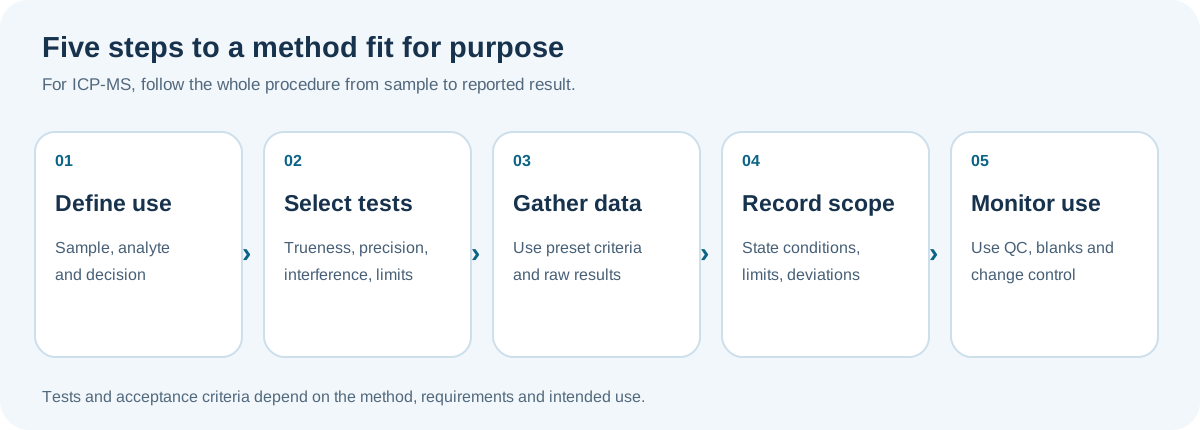
Select the relevant performance characteristics and set the study plan and acceptance criteria before seeing the results. A single fixed set of experiments is not appropriate for every method; the plan should match the intended use and risks.
Between “the instrument detected it” and “the result supports a decision”
Imagine an illustrative control limit of 10 mg/kg for element A in the product. An instrument signal alone does not show that results around 10 mg/kg can be classified correctly.
↔ 表が見切れている場合は、左右にスクロールしてご覧ください。↔ Scroll the table horizontally to see any hidden columns.
| Question for the decision | Example evidence |
|---|---|
| Can the method measure reliably around 10 mg/kg? | Trueness and precision near that level; independent quality-control (QC) results |
| Does the product matrix bias the result? | Spike recovery in a representative matrix; interference checks |
| Is A lost during preparation? | Recovery through the digestion step; a suitable certified reference material |
| If lower concentrations must be reported, how low can be quantified? | Blanks and trueness and precision near the quantitation limit |
The 10 mg/kg value is invented for explanation. Actual tolerances and acceptance criteria depend on the governing regulation or standard, customer requirements and the consequences of a wrong decision. An instrument specification must not be substituted for whole-method performance.
Choose tests by considering plausible failure modes
↔ 表が見切れている場合は、左右にスクロールしてご覧ください。↔ Scroll the table horizontally to see any hidden columns.
| Possible failure | Performance characteristic or check | ICP-MS example |
|---|---|---|
| Another component is mistaken for A | Specificity or selectivity | Investigate interfering masses, isotopes and correction settings |
| Results are consistently high or low | Trueness | Use a certified reference material, spike recovery or comparison with another method |
| Results vary between repeats | Precision | Repeat the process with independently prepared samples |
| Low-level values are unstable | Quantitation limit and range | Check blanks, trueness and precision near the lower limit |
| Small condition changes cause large result changes | Robustness | Study acceptable ranges for acid concentration or reaction conditions |
These are examples, not a mandatory test list. Select evidence that addresses the particular intended use.
When should validation or verification be considered?
Developing or introducing a new procedure
If a laboratory develops a method or extends it to an analyte or sample it has not measured before, assess the entire procedure, including preparation and calculations, rather than only the ICP-MS settings.
Adopting a published standard method in your laboratory
Even if a standard method has already been validated, the laboratory should establish that it can achieve the intended performance using its own equipment, staff, reagents and samples. This does not always require repeating a full validation from the beginning: the applicable standard and laboratory procedure determine the necessary verification.
The distinction between validation and verification and the evidence needed depend on the relevant requirements. The Eurachem guide, *The Fitness for Purpose of Analytical Methods* (third edition, 2025) discusses both. For examples involving an unchanged standard method, a modified method and a laboratory-developed method, see the Japanese guide to verification and validation under ISO/IEC 17025, the joint standard of the International Organization for Standardization and International Electrotechnical Commission.
Expanding sample types or the reportable range
Examples include transferring a water method to a high-salt matrix, adding another element or reporting a lower concentration. In ICP-MS, matrix changes can alter interference, internal-standard response, required dilution and achievable detection or quantitation limits. Evaluate the change rather than assuming that the same instrument gives the same method performance.
Making a significant procedural or equipment change
Changes to preparation, acid composition, sample mass, final volume, monitored mass, interference-removal conditions or instrument can affect results. Determine which characteristics need re-evaluation based on the change and existing evidence. The same manufacturer or model number alone does not demonstrate that a replacement instrument has no effect; equally, a scientifically justified assessment need not repeat every original experiment.
Meeting regulatory, customer or quality-system requirements
Marketing applications, laboratory accreditation, customer specifications and internal quality systems may require documented evidence. Check the applicable documents before planning experiments because terminology, data requirements and record formats differ. For example, the US Food and Drug Administration (FDA) guidance on analytical procedures and method validation for drugs and biologics addresses information supporting drug identity, strength, quality, purity and potency in applications; its scope should not be assumed to cover every industrial test.
Validation does not guarantee every later result
Validation is evidence of performance under the conditions and within the scope tested. It cannot automatically guarantee each future sample result. In routine work, monitor calibration, blanks, QC samples, internal-standard response, spike recovery, memory effects and instrument condition. Investigate unexpected samples or deviations and revise the method scope or controls where necessary.
Validation therefore leads into continuing quality control; it is not a once-only pass.
Common questions
Does a manufacturer's performance sheet remove the need for validation?
No. The sheet describes instrument performance under stated conditions, not the whole method with your samples, preparation and reporting range. Use the actual procedure to obtain the evidence needed for its purpose.
Does a high calibration-curve R² prove that the method is valid?
No. R² describes part of the relationship between concentration and response. It does not show preparation recovery, freedom from interference, trueness, precision or the lowest reliably reportable level. See the English guide to calibration curves, and review back-calculated standards and independent QC as well.
Can a standard method be used without any laboratory check?
No. Confirm that the laboratory obtains the intended performance under the method's stated conditions. Modifications or extensions may require additional validation according to their effect.
When should an established method be reviewed?
Review it when the sample type, reporting range, preparation or instrument conditions change in a way that may affect the result. Persistent QC drift or unexpected interference is another reason to investigate the cause and reassess scope.
A checklist before planning the studies
Agree with the people who will use and approve the results:
- Which decision will the result support?
- Which samples, analytes and concentration range are included?
- Which regulations, standards, customer requirements and internal procedures apply?
- Which steps, from sampling to reporting, belong to the method?
- What would be the consequence of a wrong result?
- Who will plan, perform, review and approve the work?
- Which characteristics will be tested, against what criteria?
Set acceptance criteria from the intended use and requirements in advance. Retain the plan, raw data, calculations, deviations and conclusion so that the decision can be traced.
Takeaway
Method validation demonstrates with data that a procedure is fit for its intended purpose. For ICP-MS, consider the whole path from preparation, matrix and interference through contamination and concentration conversion, not instrument sensitivity alone. Assess new or expanded methods and consequential changes; verify a standard method in the adopting laboratory as required; and use routine QC to monitor continued performance.
Further reading in Japanese: specificity, trueness, precision and robustness. The detection and quantitation limits guide is also available in English. Related Japanese guides cover ICP-MS versus ICP-OES and sample-preparation losses.
This article explains general principles, not a universal set of required tests, replicates, levels or acceptance criteria. Develop the actual plan using the applicable rules, guidance, customer requirements and laboratory quality system.