Create a chemical structure for a report or presentation without installing drawing software. This worked example uses Chemliora, a free browser-based structure editor, to draw ethyl acetate, check its connectivity and export an image. Switch the editor to English using its language control if needed.
Create the structure from SMILES
SMILES (Simplified Molecular Input Line Entry System) represents molecular connectivity as text.
- Open Chemliora and choose the SMILES input command in the File menu.
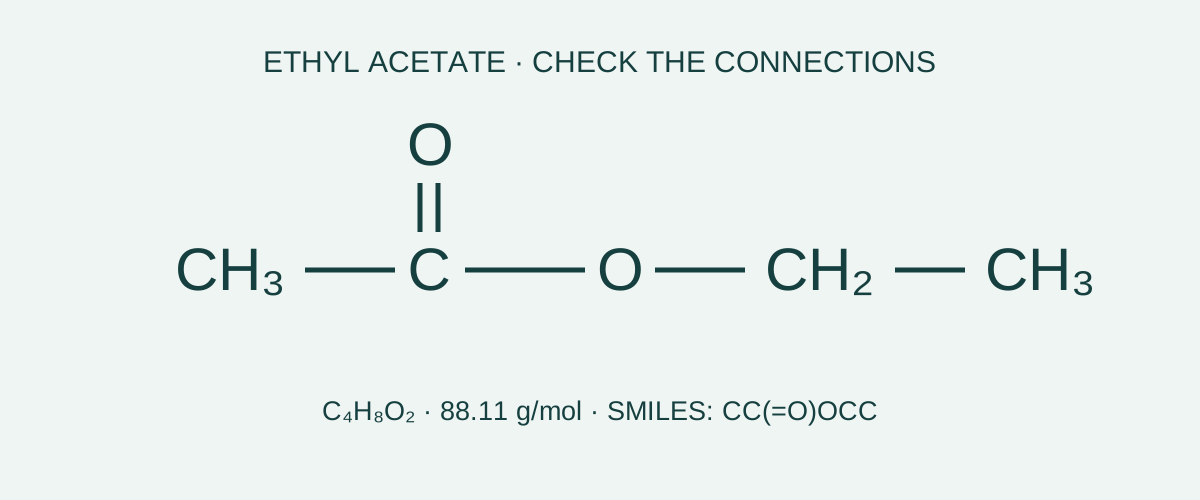
- Paste CC(=O)OCC and generate the structure.
- Check that the carbonyl carbon is bonded to an oxygen followed by a two-carbon ethyl group: CH₃–C(=O)–O–CH₂–CH₃.
- Check the molecular formula C₄H₈O₂ and molecular weight of approximately 88.11 g/mol.
PubChem also lists CCOC(=O)C, which describes the same connectivity in a different order. Matching a formula alone cannot distinguish structural isomers. Check the bonds as well as the numbers. PubChem: ethyl acetate
Prefer to draw with the mouse?
Build the carbon skeleton with single bonds, add the carbonyl double bond and place the two oxygen atoms. Unlabelled line ends and corners normally represent carbon. Use Undo to correct mistakes and the structure-cleanup command to adjust the layout. Check connectivity again after editing.
Check the structure, not just its formula
↔ 表が見切れている場合は、左右にスクロールしてご覧ください。↔ Scroll the table horizontally to see any hidden columns.
| SMILES | Structure | What to check |
|---|---|---|
| CC(=O)OCC | Ethyl acetate | Two carbons follow the ester oxygen |
| CCOC(=O)C | Ethyl acetate in another order | Same connectivity despite a different orientation |
| CCCC(=O)O | Butanoic acid | Same formula, but a terminal carboxylic acid group |
Save your current drawing as JSON before replacing it with another example. The acid and ester have the same molecular formula and calculated monoisotopic mass; neither value establishes chemical identity by itself.
Export an image and retain an editable copy
↔ 表が見切れている場合は、左右にスクロールしてご覧ください。↔ Scroll the table horizontally to see any hidden columns.
| Format | Use | Check after saving |
|---|---|---|
| PNG | Reports and slides | Labels and double bonds remain readable at the intended size |
| SVG | Scalable illustrations | Your destination application imports the image correctly |
| JSON | Continue editing in Chemliora | Reopen the file and check bonds and annotations |
Use the image export commands for PNG or SVG and the File menu to save JSON. An exported image is different from an editable project. Keep JSON if you plan to revise the drawing; do not rely solely on browser autosave. When exchanging MOL or SDF files, also open the result in the receiving application.
Explore reference spectra carefully
Chemliora includes reference predictions that help connect structural features with signals. They are not measured spectra and cannot establish sample identity.
↔ 表が見切れている場合は、左右にスクロールしてご覧ください。↔ Scroll the table horizontally to see any hidden columns.
| Feature | Look for in ethyl acetate | Limitation |
|---|---|---|
| Infrared (IR) estimate | Ester carbonyl and C–O features | Approximate structural rules; sample state matters |
| Proton nuclear magnetic resonance (¹H NMR) estimate | Three proton groups with integrals 3:2:3 | Shifts and splitting depend on model and settings |
| Electron ionization mass spectrometry (EI-MS) estimate | Candidate molecular ion and fragments | Compare with measured data and reliable libraries |
The Japanese guide records a check made with version 15.3.1 on 19 October 2026. Its numerical predictions are a historical example, not a promise of identical output in later versions. Use measured spectra, reference materials and validated methods for analytical conclusions.
Frequently asked questions
Do I need an account?
No registration or installation is required. Drawing and SMILES parsing take place in the browser. Save an editable copy yourself when you need to retain your work. External lookup features have separate data flows; consult the site's privacy information before using them.
Can I use a phone?
Yes, but precise placement is easier on a larger screen. Zoom in to check bonds and element labels. The editor supports two-finger canvas navigation on touch devices.
Can a predicted spectrum identify an unknown?
No. Structure-based reference predictions do not replace measured spectra, standards or reliable reference sources. Isomers, conformation, measurement conditions and sample state can change the observed result.
Try the complete workflow
Draw ethyl acetate in Chemliora, verify the connectivity and formula, export PNG or SVG, and save JSON for later editing.