Per- and polyfluoroalkyl substances (PFAS) are not regulated by one worldwide limit. Two familiar members are perfluorooctanesulfonic acid (PFOS) and perfluorooctanoic acid (PFOA). Japan, the United States and the European Union (EU) differ in the chemicals covered, the water or product being assessed, how concentrations are combined, and whether a requirement is already in force. This guide reflects primary regulatory sources available on 1 November 2026. For a specific product, check the legal text, destination, use, effective date and exemptions.
↔ 表が見切れている場合は、左右にスクロールしてご覧ください。↔ Scroll the table horizontally to see any hidden columns.
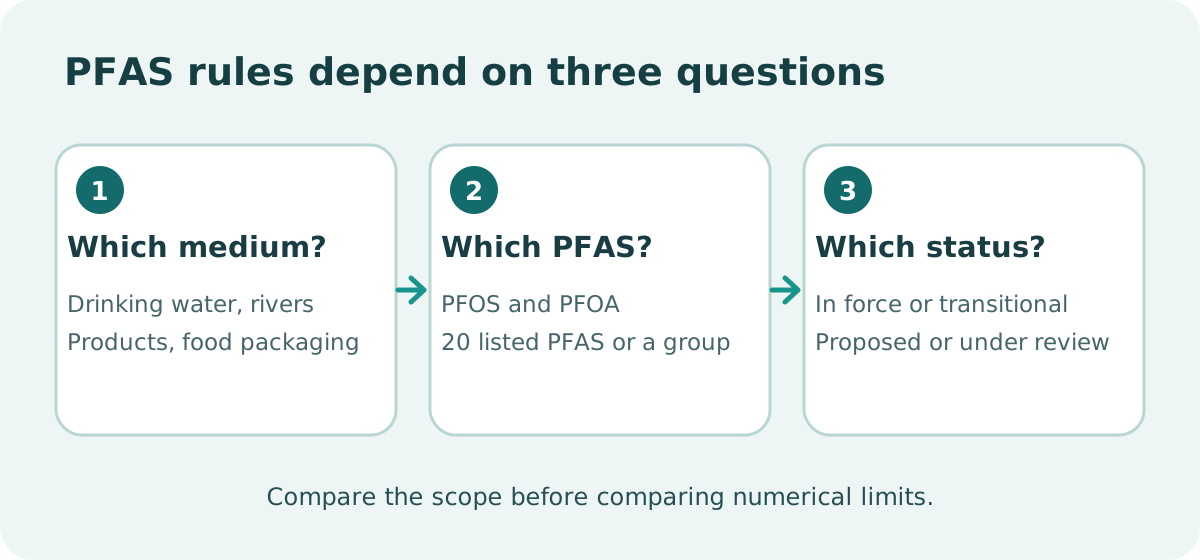
| First question | Examples |
|---|---|
| Where will it be supplied or used? | Japan, the US, the EU; also a US state or an EU member state |
| What is being assessed? | Drinking water, surface or groundwater, a product, food-contact packaging, firefighting foam, or a release |
| Which chemicals count? | Two named substances together, each substance separately, 20 listed substances together, or a wider PFAS group |
| What is the legal stage? | In force, in a transition period, proposed, or under review |
What does “PFAS” cover?
PFAS is a broad family of chemicals associated with properties such as water and oil repellency and heat resistance. A regulation may include particular salts, isomers, related substances, precursors or polymers, so the shorthand name alone does not define its full scope. The European Chemicals Agency (ECHA) overview describes the group and the EU restriction process.
↔ 表が見切れている場合は、左右にスクロールしてご覧ください。↔ Scroll the table horizontally to see any hidden columns.
| Abbreviation | Full name |
|---|---|
| PFOS | Perfluorooctanesulfonic acid |
| PFOA | Perfluorooctanoic acid |
| PFHxS | Perfluorohexanesulfonic acid |
| PFHxA | Perfluorohexanoic acid |
| PFNA | Perfluorononanoic acid |
| PFBS | Perfluorobutanesulfonic acid |
| HFPO-DA | Hexafluoropropylene oxide dimer acid, associated with GenX chemicals |
Claims such as “PFAS-free” or “PFAS compliant” are incomplete without a named rule, analyte list, sample type, unit and decision method.
Drinking-water rules: compare what is counted
↔ 表が見切れている場合は、左右にスクロールしてご覧ください。↔ Scroll the table horizontally to see any hidden columns.
| Region | Rule and analytes | How the number is applied | Status on 1 November 2026 |
|---|---|---|---|
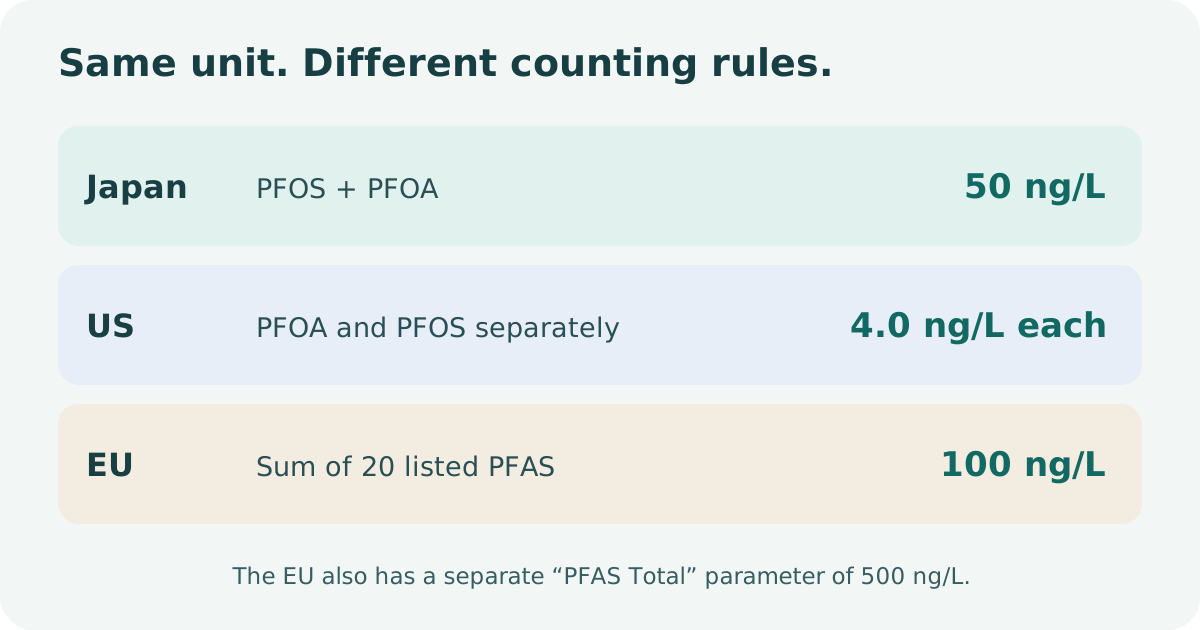
| Japan | Drinking-water standard for PFOS and PFOA | Combined concentration: no more than 50 ng/L | In force since 1 April 2026; water suppliers must test and meet the standard |
| US | Federal drinking-water rule for PFOA and PFOS | 4.0 ng/L for each substance, as a maximum contaminant level | Final 2024 rule; a proposed compliance extension is under review |
| US | Same 2024 rule for PFHxS, PFNA, HFPO-DA and certain mixtures | 10 ng/L for each of the three substances; a hazard index for certain mixtures | The Environmental Protection Agency (EPA) proposed rescission in 2026. Rescission was not final as of this article’s date |
| EU | Drinking Water Directive: “Sum of PFAS” | 0.10 µg/L = 100 ng/L for the sum of 20 listed substances | Member states had to comply by 12 January 2026 |
| EU | Drinking Water Directive: “PFAS Total” | 0.50 µg/L = 500 ng/L | A separate parameter from the 20-substance sum; check national implementation |
Japan’s 50 ng/L is the sum of PFOS and PFOA. The US 4.0 ng/L values apply individually to PFOA and PFOS. The EU 100 ng/L value is a sum of 20 specified PFAS. The numbers therefore cannot be used to rank the jurisdictions by strictness without considering analyte scope and calculation. Primary sources: Japan’s Ministry of the Environment, the US EPA drinking-water rule and 2026 proposals, and the European Commission’s guidance on the EU parameters.
Beyond drinking water: a regulatory comparison
Outside drinking water, restrictions on manufacture or import, limits for particular products, environmental releases and company reporting are handled by different legal instruments. First identify what a reference to “PFAS regulation” actually covers.
↔ 表が見切れている場合は、左右にスクロールしてご覧ください。↔ Scroll the table horizontally to see any hidden columns.
| Region and subject | Instrument | What it addresses | Status on 1 November 2026 |
|---|---|---|---|
| Japan: substances and designated products | Act on the Evaluation of Chemical Substances and Regulation of Their Manufacture, etc. (Chemical Substances Control Law), Class I Specified Chemical Substances | Manufacture and import of PFOS, PFOA, PFHxS and certain related substances are generally prohibited; check the exact substance, salts, isomers, products and exceptions | In force; it is not a blanket ban on every PFAS |
| Japan: surface and groundwater | Guideline value for public water bodies and groundwater | 50 ng/L for PFOS plus PFOA | Established; its legal role differs from the drinking-water standard |
| US: contaminated sites and releases | Comprehensive Environmental Response, Compensation, and Liability Act (CERCLA) hazardous-substance designation | PFOA and PFOS, including their salts and structural isomers, enter the release-reporting and site-response framework | In force; not a blanket product-content ban |
| US: manufacture and import information | Toxic Substances Control Act (TSCA) Section 8(a)(7) | Reporting of information about PFAS manufactured or imported during the covered period, including qualifying articles | Rule exists; confirm any changes to reporting scope and submission dates |
| US: facility release information | Toxics Release Inventory (TRI) | Covered facilities report releases and waste management for listed PFAS when reporting conditions apply | In force; not a general ban on PFAS in products |
| EU: specified PFAS | Persistent Organic Pollutants (POPs) Regulation | Restricts manufacture, placing on the market and use of PFOS, PFOA, PFHxS and certain related substances, subject to substance-specific provisions | In force; check each substance and exemption |
| EU: particular products | Registration, Evaluation, Authorisation and Restriction of Chemicals (REACH) restriction for PFHxA | Restricts PFHxA and related substances in specified consumer textiles, food packaging, cosmetics and other uses | Adopted; application dates and transition periods differ by use |
| EU: food-contact packaging | Packaging and Packaging Waste Regulation (EU) 2025/40 | Sets separate concentration conditions for individual targeted PFAS, the sum of targeted PFAS, and PFAS including polymeric forms | Applies from 12 August 2026; drinking-water limits cannot be reused |
| EU: firefighting foams | REACH restriction for PFAS in firefighting foams | Introduces use-specific limits, labelling and management requirements with phased transitions | Adopted; application dates differ by use |
| EU: wider PFAS group | Proposed broad REACH restriction | Considers restrictions across many uses of the PFAS group | Proposed and under review; it is not an enacted blanket ban |
Primary sources for this table: Japan’s Chemical Substances Control Law information and water guideline announcement; US CERCLA designation, TSCA reporting, and TRI additions; EU POPs Regulation, PFHxA restriction, packaging regulation, firefighting-foam restriction, and ECHA’s broad-restriction status.
US state rules for products and water may add requirements beyond federal law. In the EU, distinguish directly applicable regulations from the national implementation of the Drinking Water Directive.
Japan: water standards and chemical controls are different
Japan’s drinking-water standard for the combined PFOS and PFOA concentration of no more than 50 ng/L took effect in April 2026. It replaced an earlier water-quality management target with a standard requiring testing and compliance by water suppliers. The guideline value for surface and groundwater has a different legal role. Ministry of the Environment announcement
For manufacture and import, check the Class I Specified Chemical Substance designations under Japan’s Chemical Substances Control Law. PFOS, PFOA and PFHxS are among the substances subject to controls. The detailed scope of salts, isomers, related substances, designated products and exemptions must be checked substance by substance. Ministry of the Environment PFAS questions and answers
A concentration limit for water is not a product-content limit. Do not apply the 50 ng/L drinking-water value directly to a plastic part, textile or package.
United States: federal drinking water and other frameworks
The US EPA finalised a National Primary Drinking Water Regulation for six PFAS in 2024. Its maximum contaminant level (MCL) for PFOA and PFOS is 4.0 ng/L each. The 2024 rule also included 10 ng/L limits for PFHxS, PFNA and HFPO-DA and a hazard-index approach for certain mixtures that include PFBS. EPA rule summary
In May 2026, EPA published two proposals, not final revisions: one would allow qualifying systems additional time, until 2031, to meet the PFOA and PFOS limits; the other would rescind federal drinking-water requirements for PFHxS, PFNA, HFPO-DA and the relevant hazard-index mixtures. Proposed compliance extension and proposed rescission
Outside drinking water, the CERCLA designation for PFOA and PFOS, including their salts and structural isomers, concerns releases and contaminated sites. It is neither a drinking-water MCL nor a general ban on PFAS content in consumer goods. EPA CERCLA questions and answers
For products entering the US, also check the destination state, the product category and the effective date of any state rule.
EU: enacted restrictions and a broader proposal
The EU already regulates specified PFAS under its POPs Regulation and particular uses under REACH. The PFHxA restriction covers selected uses such as consumer textiles, food packaging and cosmetics, with different transition periods. It is not a single immediate ban on every product. POPs Regulation and Commission Regulation (EU) 2024/2462
The Packaging and Packaging Waste Regulation applies PFAS concentration conditions to food-contact packaging from 12 August 2026. Individual targeted PFAS, their sum, and PFAS including polymeric forms have distinct thresholds. One overall fluorine number alone does not establish compliance with every condition. Regulation (EU) 2025/40, Article 5
A proposed, wider REACH restriction covering the PFAS group is still being considered. ECHA’s Committee for Risk Assessment adopted an opinion in March 2026, while the socio-economic committee was developing its opinion. As of 1 November 2026, the broad proposal should not be described as an enacted EU-wide ban. ECHA status page
A reading order for analytical laboratories
- Identify the sample: drinking water, environmental water, a product, packaging or waste.
- Identify the jurisdiction: Japan, the US federal and state levels, or EU rules and member-state implementation.
- Copy the analyte scope from the rule: named compounds, salts, isomers, precursors, polymers and any sum.
- Match units and decision rules: do not interchange ng/L for water with mass-based product limits, or individual values with sums.
- Record the legal stage: adoption, entry into force, application date, transition period or proposal.
Selecting a PFAS analytical method before defining the regulatory analyte list risks omitting substances needed for a compliance decision. A later guide will cover PFAS methods, sample preparation, blank contamination and limits of quantitation for water and products.