
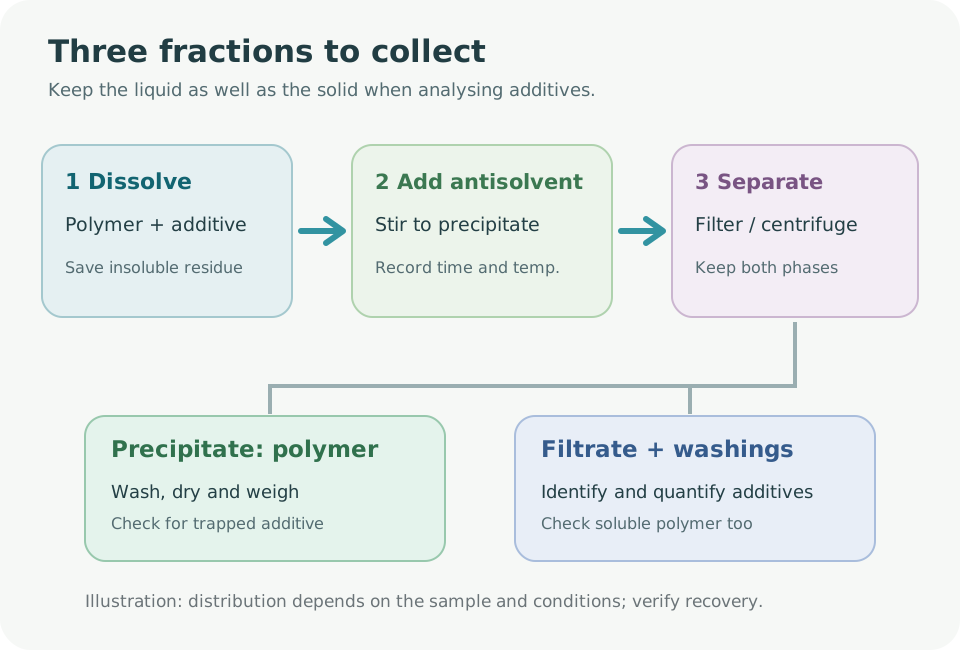
In reprecipitation, a polymer is dissolved in a good solvent and precipitated again by mixing with a poor solvent, or antisolvent. If the aim is polymer purification, the precipitate is the main product. If the aim is to identify or quantify plasticizers, antioxidants or other additives, the supernatant, filtrate and washings are analytical samples too. Decide first which components must be measured; that determines which fractions to retain and how to choose the solvents.
What does reprecipitation separate?
In a good solvent, solvated polymer chains spread through the solution. Adding an antisolvent lowers their solubility in the mixed liquid, so the chains aggregate and precipitate. This does not guarantee complete separation of polymer and additives. An additive may be trapped in the precipitate; insoluble fillers may remain before precipitation; and low-molecular-weight polymer may pass into the filtrate. See the research review on dissolution and precipitation.
↔ 表が見切れている場合は、左右にスクロールしてご覧ください。↔ Scroll the table horizontally to see any hidden columns.
| Analytical purpose | Main fraction to keep | Additional checks |
|---|---|---|
| Purify polymer for molecular-weight or thermal-property measurements | Washed and dried precipitate | Yield, residual solvent and loss of low-molecular-weight material |
| Identify or quantify additives | Collect the filtrate and each washing separately | Residue in the precipitate, preparation recovery and solvent blank |
| Separate inorganic fillers or pigments | Insoluble matter removed after dissolution, before reprecipitation | Adhering polymer/additive and passage of fine particles |
Procedure: establish conditions on a small scale first
- Define the target. Identify the polymer, candidate additives, solvent compatibility, and any crosslinking or composite components. Prepare solvent and container blanks.
- Dissolve a small sample in a good solvent. Reduce particle size and stir until dissolution is complete. Use only the heating needed, recording temperature and time. Collect any insoluble residue separately.
- Separate insoluble material. If pigments, glass fibres or undissolved resin are present, filter or centrifuge and record the mass and appearance of this fraction.
- Stir an adequate volume of antisolvent. Add the polymer solution gradually. Watch for clouding or stringy or lump-like precipitation and changes in the supernatant. Record addition rate, temperature and volume ratio.
- Separate and wash the precipitate. Filter or centrifuge, then wash it with fresh antisolvent. Keep the filtrate and washings separately; do not discard them.
- Finish for the intended measurement. Dry the polymer under conditions suitable for that material. Concentrate or exchange the solvent of additive-containing fractions to match the solvent used for gas chromatography (GC), liquid chromatography (LC) or another measurement.
For a starting trial, a dilute polymer solution may be added dropwise to a stirred excess of antisolvent. There is no universal antisolvent-to-solution ratio. Concentration, molecular weight, comonomer ratio, crystallinity, temperature, water and additive content can change both precipitate form and recovery. If the polymer forms lumps, compare lower solution concentration, slower addition and stronger stirring in small trials. See a study of conditions affecting precipitation and purity.
Polymer-specific examples of good solvent and antisolvent pairs
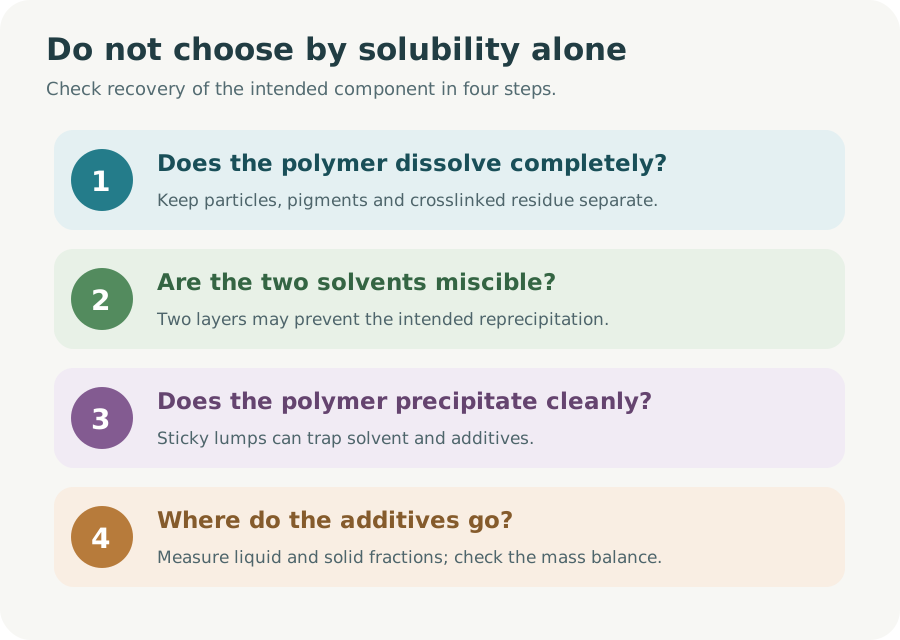
The pairs below are starting conditions reported for particular research samples, not validated recipes for every commercial product. Plasticizers, copolymers, fillers, molecular weight and crystallinity can alter the result. With the actual sample, confirm complete dissolution, solvent miscibility, clean precipitation and the distribution of the additive of interest.
↔ 表が見切れている場合は、左右にスクロールしてご覧ください。↔ Scroll the table horizontally to see any hidden columns.
| Polymer | Reported good solvent → antisolvent | Points to verify when setting conditions | Source |
|---|---|---|---|
| PS (polystyrene) | Toluene → methanol | Check whether low-molecular-weight fractions remain in the filtrate | PS precipitation study |
| PMMA (poly(methyl methacrylate)) | Tetrahydrofuran (THF) → methanol | Concentrated solutions may form gels or large clumps | PMMA reprecipitation example |
| PVC (poly(vinyl chloride)) | THF → methanol | With highly plasticized products, test whether plasticizer is trapped in the precipitate | PVC solvent-composition study |
| PLA (poly(lactic acid)) | Chloroform → cold methanol | Reported for recovery of commercial PLA filament; avoid unnecessary heat or long holding times and check molecular weight | PLA filament recovery, section 2.3.2 |
| PC (polycarbonate) | Dichloromethane → methanol | Check retention of low-molecular-weight substances such as bisphenols | PC reprecipitation example |
| PVDF (poly(vinylidene fluoride)) | N,N-dimethylacetamide (DMAc) → water | Watch water uptake and residual solvent; phase separation resembles membrane formation and can change morphology | PVDF–DMAc–water phase-diagram study |
| PP (polypropylene) | Hot xylene → ethanol | Reported for nanoparticle preparation with dissolution at 140 °C; not a validated routine purification or additive assay | PP nanoparticle preparation study |
| PET (poly(ethylene terephthalate)) | Hot benzyl alcohol → ethanol | Nanoparticle-preparation example with dissolution at 180 °C; check thermal degradation and residual solvent, and consider another extraction method for additive analysis | PET nanoparticle preparation study |
| PA6 (polyamide 6, nylon 6) | Formic acid → water | Reported for resin recovery from a ramie-fibre composite: remove fibre first, then precipitate in water; check changes after prolonged acid exposure | PA6 recovery, section 2.3.3 |
| ABS (acrylonitrile–butadiene–styrene) | Acetone → water | Rubber phase or formulation may prevent complete dissolution; collect insoluble residue separately | ABS dissolution and precipitation study |
| PVAc (poly(vinyl acetate)) | Acetone → n-hexane | Low-molecular-weight grades and adhesive formulations may form sticky precipitates | PVAc reprecipitation example |
| PCL (polycaprolactone) | Chloroform → methanol | Check loss of low-molecular-weight material to the filtrate | PCL reprecipitation example |
| PEG (poly(ethylene glycol)) derivatives | Dichloromethane → diethyl ether | Depending on molecular weight and end groups, material may remain liquid or soluble; determine the molecular-weight range actually recovered | PEG-derivative precipitation example |
| PBS (poly(butylene succinate)) | Chloroform → methanol | Crystallization and comonomer ratio can alter precipitate form | PBS reprecipitation example |
| PHB (poly(3-hydroxybutyrate)) | Chloroform → n-hexane | Remove biological insoluble matter first; check molecular-weight changes caused by heat and solvent history | PHB purification example |
These are examples reported for the samples in the cited sources, not product-specific recommendations. The high-temperature PET procedure, acid dissolution of PA6 and composition-dependent behaviour of ABS particularly require checks for polymer alteration and additive recovery. Crosslinked rubber and highly filled composites may not dissolve completely, so another extraction or separation method may be needed. If only the additives are of interest, solvent extraction without fully dissolving the resin can sometimes be more suitable. See a study of solvent selection for additive extraction.
Common additive-analysis failures and checks
↔ 表が見切れている場合は、左右にスクロールしてご覧ください。↔ Scroll the table horizontally to see any hidden columns.
| What happens | Effect on the result | Check or response |
|---|---|---|
| A sticky lump precipitates | Solvent and additives are trapped inside, potentially lowering the measured additive amount | Dilute the solution or change addition conditions; redissolve the precipitate and measure what remains |
| The additive also precipitates in the antisolvent | Measuring only the filtrate gives a low result | Add an additive standard to the solvent mixture and check both precipitate and filtrate |
| Low-molecular-weight polymer stays in the filtrate | GC/LC contamination and reduced polymer yield | Examine filtrate residue and size-exclusion chromatography (SEC), with further cleanup if needed |
| Compounds leach from solvent, filter or apparatus | False peaks or elevated results | Run a full-process blank and a filter blank; check glassware compatibility |
| Evaporation, oxidation or hydrolysis occurs | Less additive or more degradation products | Use gentle drying/concentration, control light, oxygen and temperature, and test storage stability |
Evaluate recovery by adding the additive standard before preparation. Spiking only the final filtrate can reveal measurement interference but cannot measure losses during reprecipitation. Where feasible, analyse the filtrate, washings and dried precipitate separately, then compare their total with the amount added. For polymer purification, assess residual solvent and molecular-weight distribution as well as mass before and after drying. Dissolution and precipitation can remove some additives while leaving, for example, colouring matter behind. See a reported example of pigment retention.
Before discarding a fraction: follow an illustrative 100 µg additive spike
The numbers below are invented to explain spike recovery and mass balance. They do not represent recovery from a real polymer/additive pair. Imagine equivalent unspiked and spiked samples. Add 100 µg of the target additive before preparation to the spiked sample; process both in the same way. Quantify each fraction separately and subtract the amount in the unspiked sample. Check a full-process blank as well.
↔ 表が見切れている場合は、左右にスクロールしてご覧ください。↔ Scroll the table horizontally to see any hidden columns.
| Collected fraction | Increase due to the spike | Percentage of the 100 µg spike |
|---|---|---|
| Main filtrate after reprecipitation | 72 µg | 72% |
| Precipitate washings | 18 µg | 18% |
| Separate extract of the precipitate | 7 µg | 7% |
| Extract of insoluble material removed before reprecipitation | 1 µg | 1% |
| Total | 98 µg | 98% |
Measuring only the main filtrate gives 72% recovery. Collecting the washings as well gives (72 + 18) / 100 × 100 = 90%. Distinguish the 98% mass balance across all fractions from the 90% recovery of a routine method that measures only filtrate and washings. The table cannot locate the missing 2%; transfer losses, decomposition and measurement variation are possibilities to investigate. Do not automatically label 98% as “no loss.”
Calculate each amount from fraction concentration × final liquid volume × any dilution factor not yet applied. Do not mix µg/L with mL without converting units. Check recovery when extracting the precipitate or insoluble matter. Combine filtrate and washings only after checking their distribution, and avoid counting a fraction twice.
Judge recovery against the intended use and criteria set in advance. A separate post-preparation spike can help distinguish preparation loss from measurement-stage matrix effects. Still, a spiked standard may behave differently from an additive already present in the product; spike recovery alone does not prove complete extraction from real samples.
Safety and records
Handle THF, toluene, xylene and chlorinated solvents according to the facility's safety data sheets (SDS), fume-hood rules and waste streams. Pay attention to THF peroxide formation, splashing of hot solvents, heating in closed vessels and exposure to dichloromethane or chloroform. Do not add antisolvent all at once to a boiling solvent.
Record sample identity and mass; solvent grades and volumes; dissolution temperature and time; precipitation temperature, addition order and rate; separation, washing and drying conditions; mass or volume of each fraction; blanks; and recovery. These details help explain changes in polymer yield or additive result.
The key check is not merely whether a white precipitate formed. Determine which fraction contains the target component and how much is recovered before treating reprecipitation as a reliable purification or additive-analysis preparation step.