

For a conventional closed-shell molecule in its ground state, the highest occupied molecular orbital (HOMO) is the highest-energy orbital containing electrons. The lowest unoccupied molecular orbital (LUMO) is the lowest-energy orbital without electrons. These frontier orbitals help us consider how one molecule might donate electrons and another might accept them. They do not, by themselves, predict a reaction outcome. See the IUPAC Gold Book definition of frontier orbitals.
↔ 表が見切れている場合は、左右にスクロールしてご覧ください。↔ Scroll the table horizontally to see any hidden columns.
| Question | Short answer |
|---|---|
| What is the difference? | HOMO is occupied; LUMO is the first unoccupied orbital above it. |
| Why do they matter in reactions? | The occupied orbital of an electron donor can interact with an acceptor's unoccupied orbital. |
| How is the gap calculated? | Subtract the HOMO energy from the LUMO energy, using values from the same calculation. |
| Do red and blue lobes mean positive and negative charge? | No. They normally distinguish the sign, or phase, of an orbital. |
| Does a smaller gap always mean a faster reaction? | No. The reacting partner, orbital overlap, geometry and other factors matter. |
Our Chemliora structure editor can perform a simplified HOMO–LUMO calculation from a molecular structure and display orbital energies and 3D surfaces. This guide explains how to read its output and where its conclusions stop.
HOMO and LUMO mark a boundary
↔ 表が見切れている場合は、左右にスクロールしてご覧ください。↔ Scroll the table horizontally to see any hidden columns.
| Term | Full name | What to look for |
|---|---|---|
| HOMO | Highest occupied molecular orbital | The uppermost occupied orbital |
| LUMO | Lowest unoccupied molecular orbital | The first empty orbital above the occupied set |
| HOMO–LUMO gap | Difference between their orbital energies | LUMO energy minus HOMO energy |
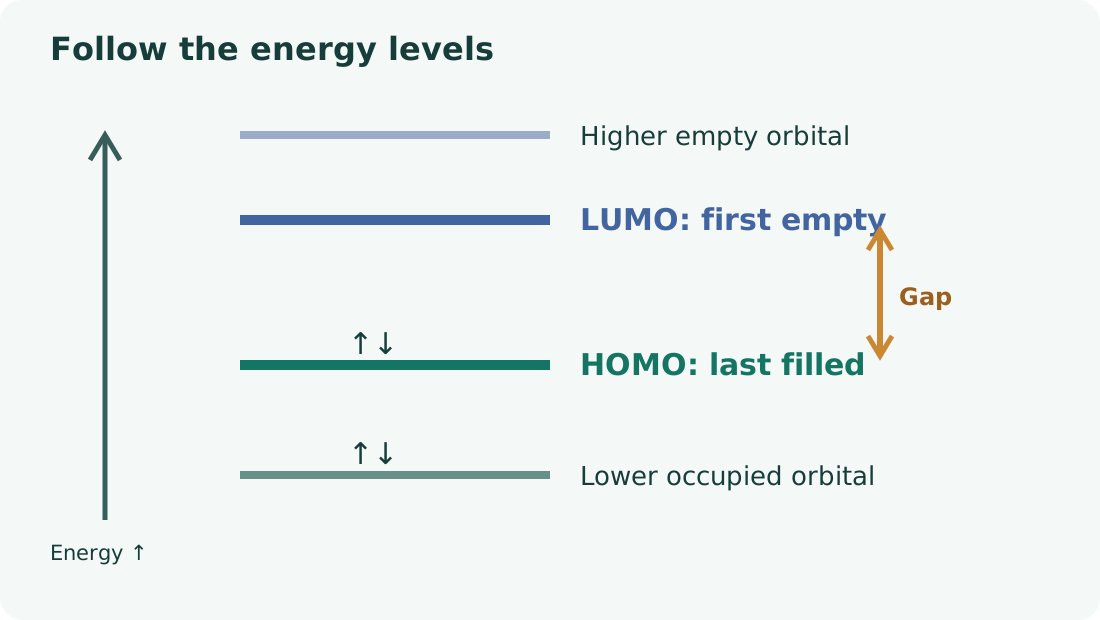
In an energy-level diagram, higher levels represent higher orbital energies. For an ordinary closed-shell molecule, occupied orbitals are commonly drawn with two electrons each. The first empty level above the HOMO is the LUMO. The gap is an orbital-energy difference, not automatically a measured optical excitation energy.
The image of electrons taking “seats” is only a memory aid for energy ordering. An orbital is a wavefunction, not a fixed route or a small compartment inside the molecule. “Highest” in HOMO refers to energy, not to a position in space. Open-shell systems, such as radicals, require additional care: a singly occupied molecular orbital (SOMO) and spin-specific orbitals can be relevant.
What do orbital shape and colour mean?
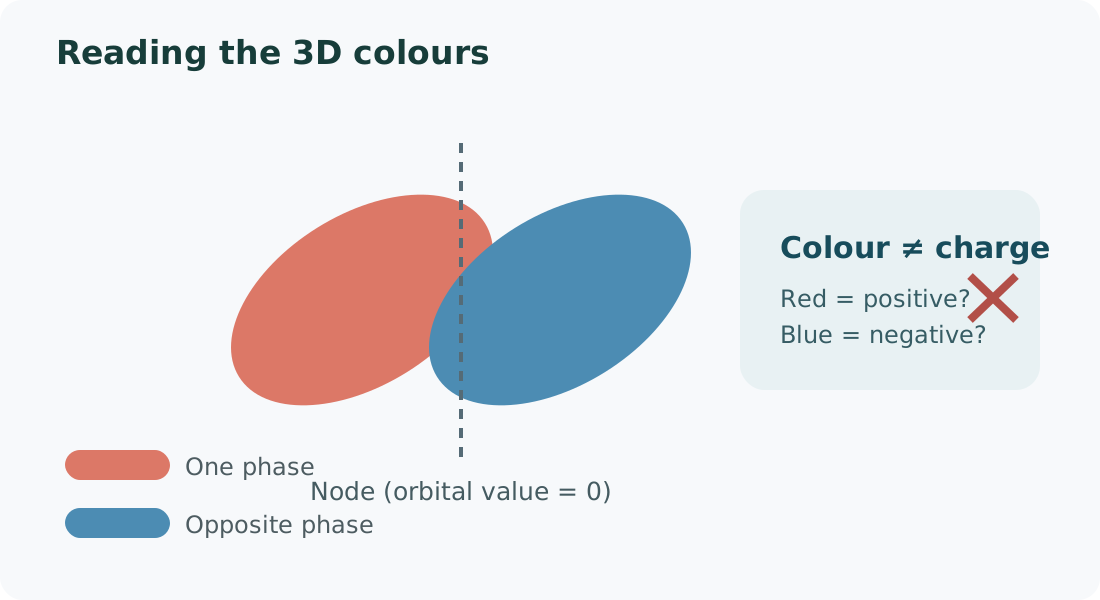
In a typical 3D orbital view, the colours indicate opposite signs, or phases, of the wavefunction. A red region is not necessarily positively charged, and a blue one is not necessarily negatively charged. A node is a region where the orbital value is zero. The displayed lobes are isosurfaces drawn at a chosen value; they do not confine every electron to the visible surface.
Shape and orientation can help when considering overlap with another orbital. But the HOMO shape alone cannot identify a guaranteed reaction site, and the LUMO colour alone cannot establish charge. The other reactant, steric effects, solvent, molecular charge and additional orbitals also matter.
Calculate the gap by subtraction
HOMO–LUMO gap (eV) = LUMO energy (eV) − HOMO energy (eV).
For a purely illustrative example, if HOMO = −6.0 eV and LUMO = +1.5 eV, the difference is 1.5 − (−6.0) = 7.5 eV. These are invented values for practising the subtraction, not measurements of a particular substance.
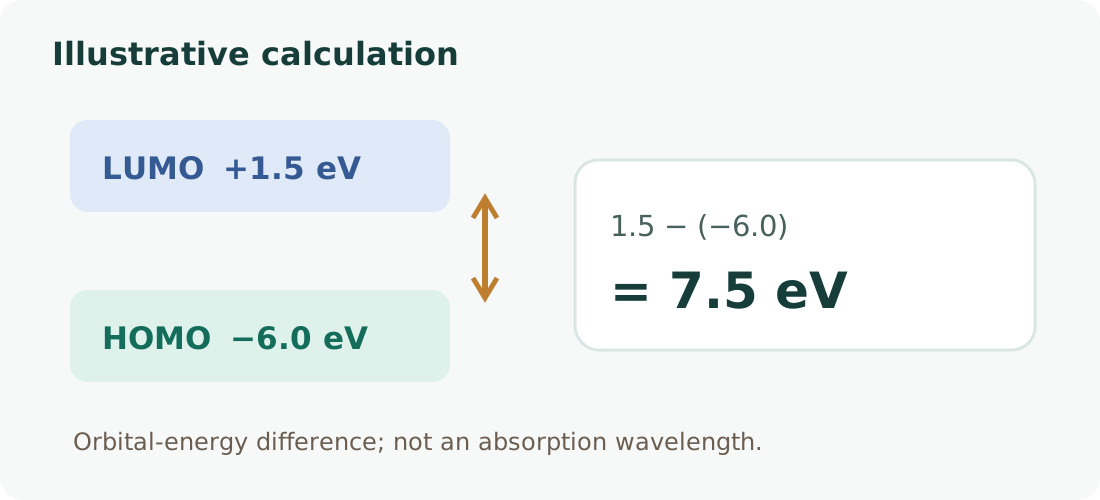
Comparing molecules with the same computational method and conditions can provide a qualitative clue about changes in frontier-orbital energies. Do not directly convert a HOMO–LUMO gap into an absorption maximum, emission wavelength, redox potential or reaction rate. Excited-state calculations must account for changes beyond these ground-state orbital energies. See the Q-Chem manual on excited states.
Worked concept: ethylene
Ethylene (ethene, CH₂=CH₂) has a π bond in addition to its σ framework. Combining the carbon p orbitals gives a lower-energy bonding π orbital and a higher-energy antibonding π* orbital. In the ground state, two π electrons occupy the bonding orbital, while the π* orbital is empty. In the usual molecular-orbital description of ethylene, the π orbital is the HOMO and the π* orbital is the LUMO. See OpenStax on molecular orbitals in π systems.
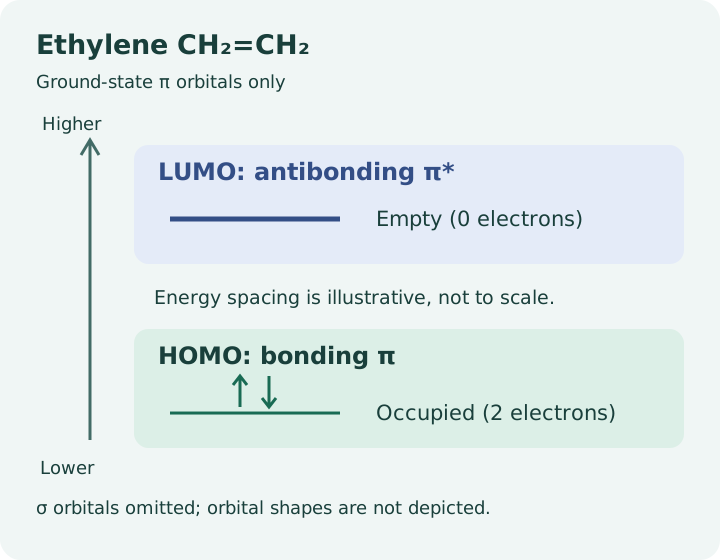
The lesson is to look at the occupied and empty orbitals at the boundary when considering electron donation and acceptance. The HOMO is not a π orbital in every molecule. A lone-pair-derived orbital, for example, may be the HOMO elsewhere.
For reactions, consider the other molecule
The HOMO is a starting point for thinking about an electron donor; the LUMO is a starting point for an electron acceptor. In a nucleophile–electrophile reaction, for instance, consider the nucleophile's HOMO and the electrophile's LUMO. This is different from looking only at the HOMO–LUMO gap within either molecule.
The energy separation, approach direction, orbital phase and overlap, and the orbital's contribution at the reacting atoms all affect the interaction. Neither a high HOMO energy nor a low LUMO energy alone determines a reaction site or rate.
Common questions about signs and gaps
Is a “higher” HOMO a more negative number?
No. On the number line, −5 eV is higher than −8 eV. Do not confuse the value with its absolute magnitude. Avoid comparing energies computed with different methods, basis sets or charge states without further justification.
If the LUMO energy is negative, is the gap negative?
Not necessarily. If HOMO = −6 eV and LUMO = −2 eV, then −2 − (−6) = 4 eV. First check which level is higher. These numbers illustrate subtraction; they are not measured electron affinities.
Can the gap alone tell me a molecule's colour?
No. Observed colour depends on actual absorption energies, transition strengths, solvent and other conditions. A simple orbital-energy gap is not identical to an optical excitation energy, so converting it directly to a wavelength can be misleading.
Run Chemliora's simplified calculation
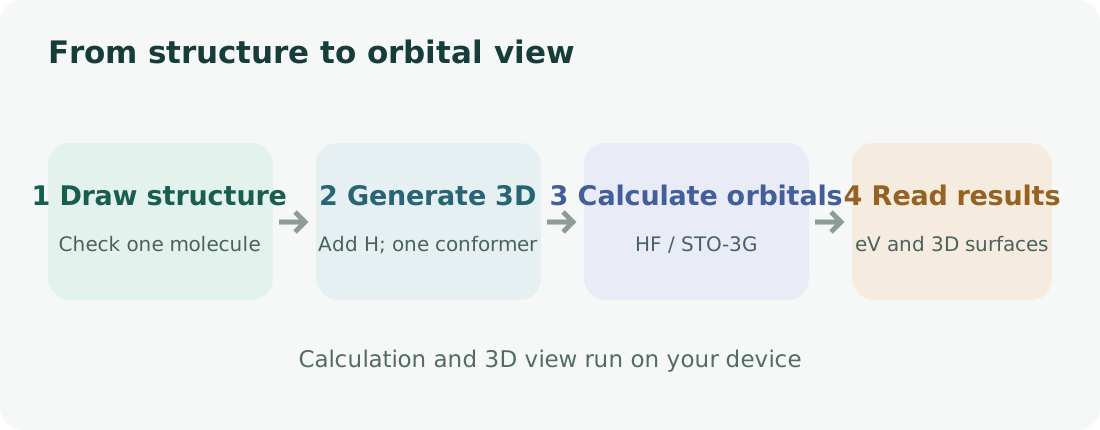
- Draw one molecule in the structure editor. Check the bonds, formal charges and hydrogen count.
- Open Structure & Analysis, then choose the simplified HOMO–LUMO calculation.
- Follow the calculation stages and elapsed time. You can cancel a long calculation.
- Read the HOMO and LUMO energies in eV, their difference and the 3D orbital surfaces. Switch between the two orbital views to compare shapes.
The tool adds hydrogens, creates one 3D conformer, and calculates orbitals using the Hartree–Fock method with the small STO-3G basis set. It uses restricted Hartree–Fock (RHF) for ordinary closed-shell molecules and unrestricted Hartree–Fock (UHF) for odd-electron molecules. Energies are converted from hartree to eV (1 hartree ≈ 27.2114 eV). STO-3G is a minimal basis suited to orientation and learning, not a precision property prediction. See the Psi4 discussion of Hartree–Fock and STO-3G.
Read an actual ethylene result
On 19 October 2026, we tested Chemliora version 15.3.1 locally by generating neutral ethylene from the Simplified Molecular Input Line Entry System (SMILES) string C=C, then selecting Structure & Analysis → HOMO–LUMO. We checked the two carbon atoms, the double bond and formula C₂H₄. Hydrogen addition for the calculation brings the total to six atoms.
↔ 表が見切れている場合は、左右にスクロールしてご覧ください。↔ Scroll the table horizontally to see any hidden columns.
| Item | Result in this run | How to read it |
|---|---|---|
| Input | SMILES C=C, neutral C₂H₄ | Verify bonds and hydrogen count first |
| Calculation | RHF/STO-3G, one generated conformer | No solvent or conformer ensemble is represented |
| Detail | 6 atoms, 14 basis functions, 16 electrons, converged in 8 iterations | The calculation includes added hydrogens |
| HOMO | −9.18 eV | Highest occupied orbital energy under these conditions |
| LUMO | +8.10 eV | Lowest unoccupied orbital energy under these conditions |
| Gap | 17.28 eV | 8.10 − (−9.18) = 17.28 eV |
These numbers are reference output from this simplified run, not measured excitation energies, electron affinity or an absorption wavelength for ethylene. In particular, do not treat the empty-orbital energy from a minimal basis as a precise material property. A rerun may differ with conformer generation or software changes. When comparing results, check the structure, charge, conformer, method, basis set and convergence.
The HOMO/LUMO display buttons switch the visible orbital within the same calculation; they do not launch a new calculation. Keep the earlier π-orbital concept diagram separate from this numerical result.
Checklist before comparing results
↔ 表が見切れている場合は、左右にスクロールしてご覧ください。↔ Scroll the table horizontally to see any hidden columns.
| Check | Why it matters | Practical step |
|---|---|---|
| Bonds, formal charge and formula | Change the electron count and orbitals | Confirm the input structure |
| 3D conformer | Geometry can change orbital energies | Record that only one conformer was calculated |
| Method and basis set | Change energies and empty-orbital shapes | Compare only like-for-like calculations |
| Solvent and neighbours | Not included in this simplified calculation | Do not mistake it for an experimental environment |
| Molecular size | Increases time and memory demand | Start with small molecules within tool limits |
The function is limited to 140 basis functions on desktop and 100 on mobile. Large molecules and unsupported elements may fail. For conformer ensembles, solvent effects, reliable excitation energies or quantitative reactivity predictions, use methods chosen for that purpose and check against measurements.
A practical reading order
- Check the input: one intended molecule, with correct bonds, charge and hydrogens.
- Inspect the surfaces: compare their extent, nodes and possible overlap with a reacting partner.
- Read the numbers: use energies and their difference only as conditional comparison points.
- Limit the conclusion: do not infer absorption wavelengths or guaranteed reaction sites from these outputs alone.
Try a small molecule in the Chemliora structure editor and compare the drawing with the 3D views.