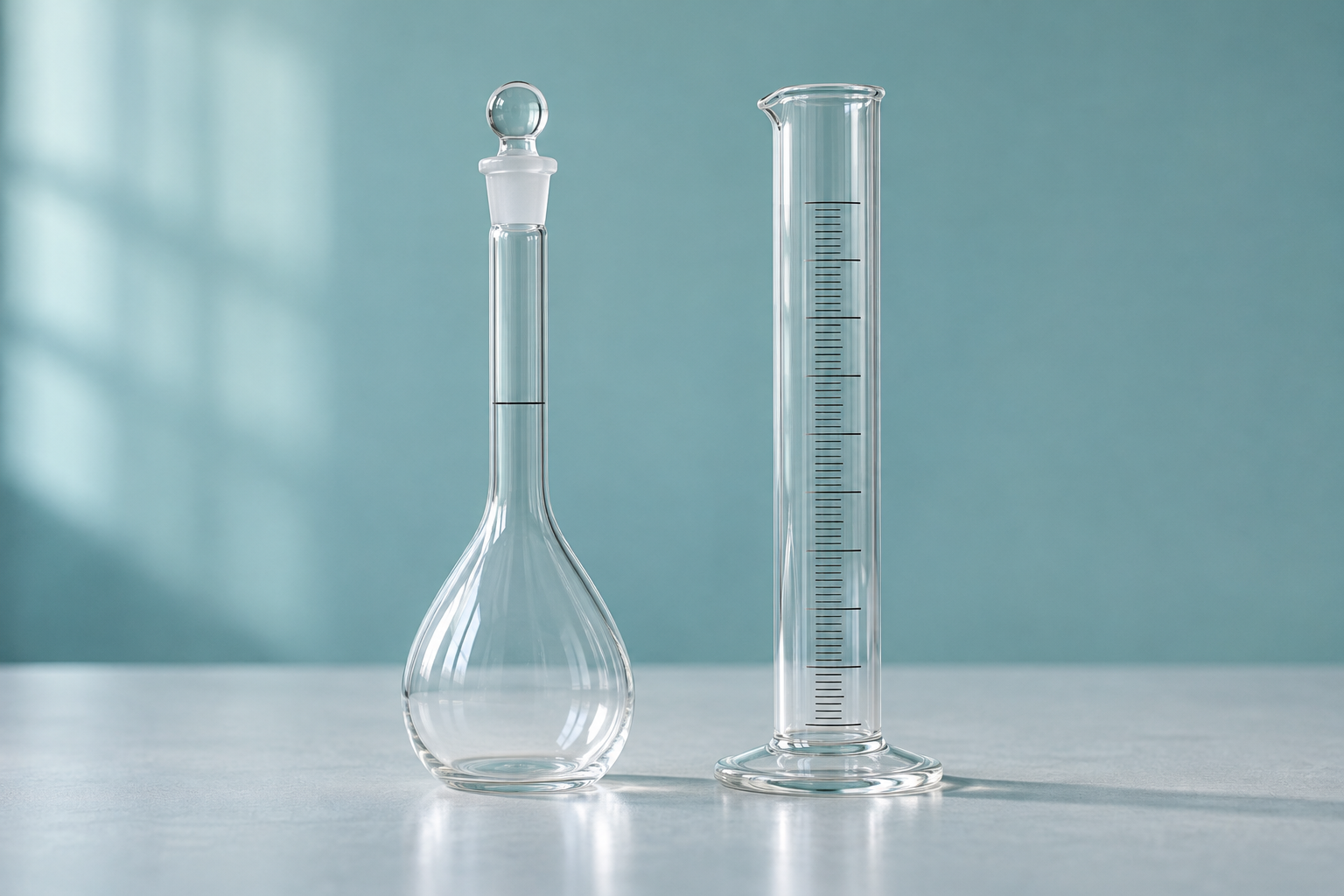
Use a volumetric flask to make a solution up to a fixed final volume. Use a graduated cylinder to measure different volumes along a scale. At 100 mL, the Japanese Industrial Standards (JIS) Class A tolerance for the glassware compared here is ±0.10 mL for a volumetric flask and ±0.50 mL for a graduated cylinder. Choose a flask to make a calibration standard up to 100 mL and a cylinder to measure approximately 100 mL of reagent. SIBATA’s JIS tolerance table
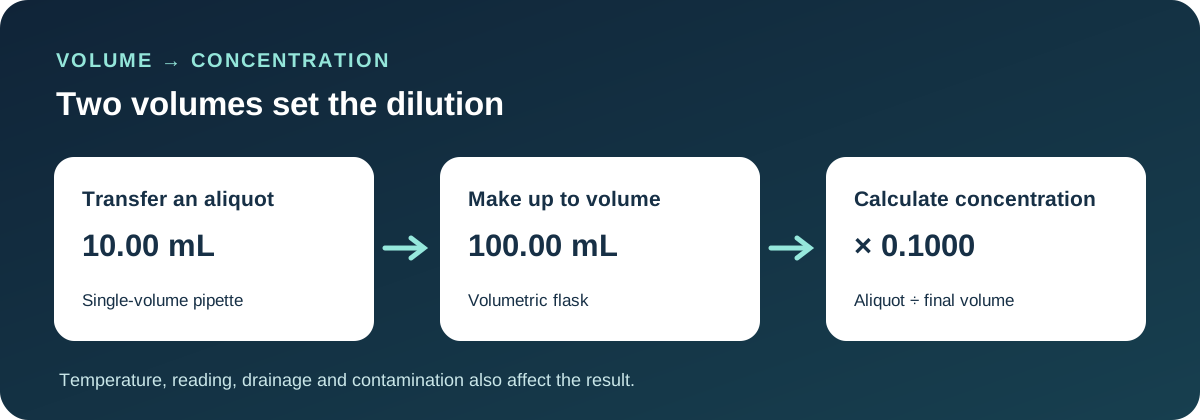
For transferring liquid, a single-volume pipette suits a fixed aliquot and a graduated pipette suits variable volumes. The volume error in either the transfer or the final volume affects the calculated concentration.
Which volumetric instrument should you use?
↔ 表が見切れている場合は、左右にスクロールしてご覧ください。↔ Scroll the table horizontally to see any hidden columns.
| Task | First choice | What to check |
|---|---|---|
| Make a standard solution up to a specified volume | Volumetric flask | One calibration line sets the total volume. Choose a flask marked to contain (TC or In) |
| Transfer the same volume accurately each time | Single-volume pipette, also called a volumetric pipette | A fixed volume delivered under the specified drainage conditions. Look for to deliver (TD or Ex) |
| Measure an approximate amount of reagent or rinse liquid | Graduated cylinder | Choose a suitable capacity and scale interval |
| Transfer different volumes with one pipette | Graduated pipette | Check the scale, delivery endpoint and the interval you will use |
| Handle a liquid containing hydrofluoric acid (HF) or reduce breakage risk | Compatible plastic labware | Verify chemical compatibility, tolerance and the containment or delivery marking for the actual product |
Single-volume pipette or graduated cylinder? Use a 10 mL single-volume pipette to transfer 10.00 mL of stock solution each time. A graduated cylinder is convenient for measuring about 10 mL of rinse liquid. When you pour from a cylinder marked to contain, liquid remaining on the wall reduces the amount delivered. Use a delivery-calibrated instrument and its specified technique when the transferred volume matters.
Class A tolerances for 100 mL and 10 mL glassware
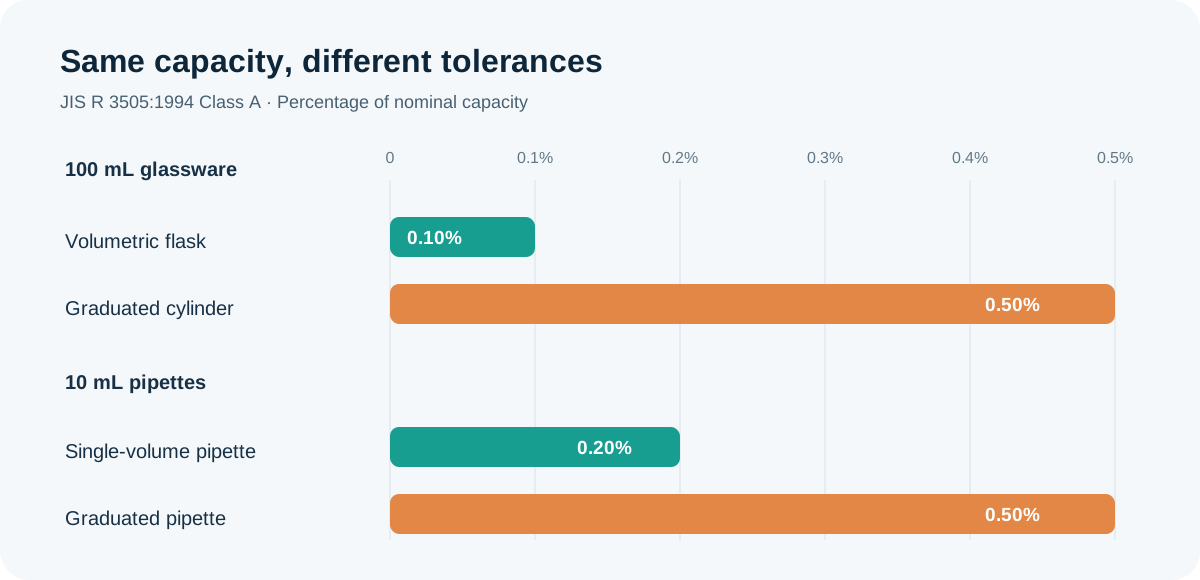
JIS R 3505:1994 covers Japanese glassware specifications and distinguishes Class A and Class B. Class A has tighter tolerances for the instruments compared here. International Organization for Standardization (ISO) specifications include ISO 1042 for one-mark volumetric flasks, ISO 4788 for graduated measuring cylinders, ISO 648 for single-volume pipettes and ISO 835 for graduated pipettes. ISO 4787:2021 covers capacity testing, calibration and use. Compare tolerances under the same specification and for the same capacity and instrument type.
↔ 表が見切れている場合は、左右にスクロールしてご覧ください。↔ Scroll the table horizontally to see any hidden columns.
| Instrument | Nominal capacity | JIS Class A tolerance | Relative tolerance | Typical use |
|---|---|---|---|---|
| Volumetric flask | 100 mL | ±0.10 mL | ±0.10% | Make up to volume |
| Graduated cylinder | 100 mL | ±0.50 mL | ±0.50% | Measure approximate quantities |
| Single-volume pipette | 10 mL | ±0.02 mL | ±0.20% | Transfer a fixed aliquot |
| Graduated pipette | 10 mL | ±0.05 mL | ±0.50% | Transfer different volumes |
At 100 mL the cylinder’s tolerance is five times the flask’s. At 10 mL the graduated pipette’s tolerance is 2.5 times the single-volume pipette’s. At the 100 mL line, the corresponding tolerance ranges are 99.90–100.10 mL for the flask and 99.50–100.50 mL for the cylinder. These are permissible deviations under the stated specification. A calibration certificate gives the result and uncertainty for an individual instrument. SIBATA’s JIS tolerance table
Scale interval, tolerance and repeatability describe different properties. The scale interval is the volume between adjacent graduations. Tolerance limits the permitted deviation from the nominal volume. Repeatability describes how much results vary when the operation is repeated under the same conditions. Check the stated tolerance and calibration result even when the scale graduations are closely spaced.
Why a volumetric flask is easier to set accurately
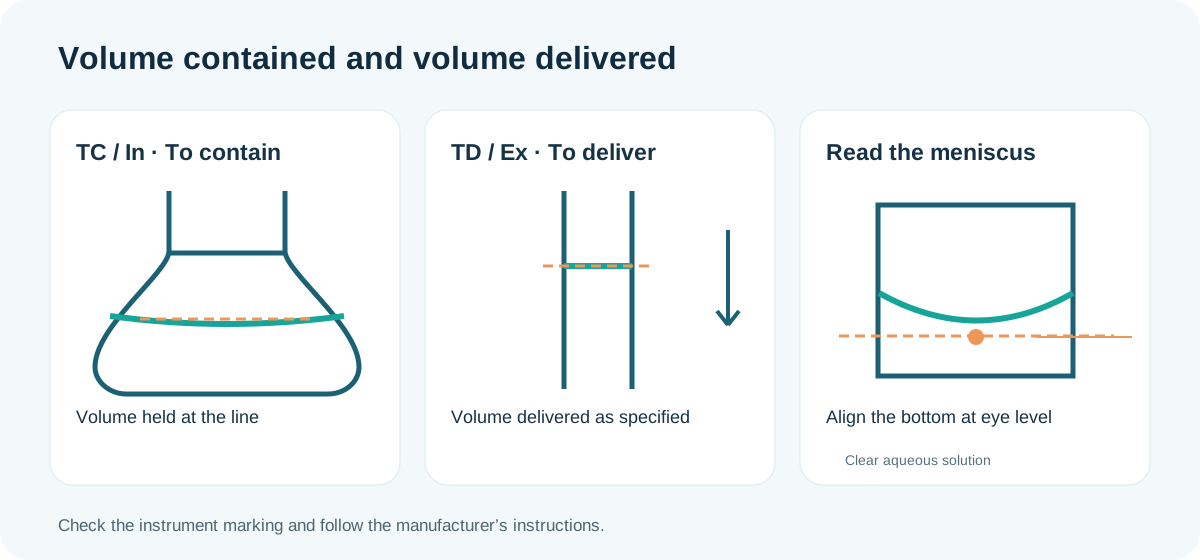
To make up to volume, add solvent until the entire solution reaches the target volume. Dissolve the sample and let the solution reach the working temperature. Add the last portion of solvent drop by drop. For a clear aqueous solution, align the bottom of the meniscus with the line at eye level. Stopper and mix thoroughly by inversion. If you fill a flask while the solution is hot, the liquid volume will change as it cools.
A drop raises the liquid level more in the flask’s narrow neck. The mark is therefore easier to approach precisely. For the same vertical reading error, a wider cross-section produces a larger volume error. Near the mark, even the last drop can take the liquid past the line. SIBATA’s volumetric flask specifications
How do you reduce error when using a graduated cylinder? Set it on a level surface and read at eye level. If you need 20 mL, choose a cylinder with a 20 mL graduation and verify that the interval and tolerance at that volume suit the task. Check the contain or deliver marking if you plan to transfer the liquid.
Single-volume pipette vs graduated pipette
A single-volume pipette delivers its nominal volume under specified conditions. Use it when you repeatedly need 10.00 mL. A graduated pipette can deliver 4 mL, 6 mL or 8 mL from the same instrument. Some designs deliver to the tip, while others use an interval between graduations. Consult the product specification before using the full-capacity tolerance to assess a partial delivery. SIBATA’s laboratory glassware catalogue
Use a pipette filler. Follow the stated drainage and waiting times, and blow out the tip only when the marking or instructions specify it. Blowing out the remaining liquid in a pipette calibrated for gravity drainage can deliver more than the calibrated volume.
Worked example: diluting 10 mL to 100 mL
Transfer 10.00 mL of a 100 mg/L stock standard and make it up to 100.00 mL. The nominal concentration is 10.00 mg/L. Multiply the stock concentration by the aliquot volume divided by the final volume. A larger aliquot combined with a smaller final volume raises the concentration, and the opposite combination lowers it.
↔ 表が見切れている場合は、左右にスクロールしてご覧ください。↔ Scroll the table horizontally to see any hidden columns.
| Instruments | Extreme aliquot-to-final-volume ratios | Resulting concentration | Deviation from nominal |
|---|---|---|---|
| 10 mL single-volume pipette and 100 mL volumetric flask | 9.98 ÷ 100.10 to 10.02 ÷ 99.90 | 9.97–10.03 mg/L | About ±0.30% |
| 10 mL graduated pipette and 100 mL graduated cylinder | 9.95 ÷ 100.5 to 10.05 ÷ 99.5 | 9.90–10.10 mg/L | About ±1.0% |
The table uses the extreme permitted volumes in the JIS Class A example and assumes an exact stock concentration. To estimate measurement uncertainty separately, evaluate calibration uncertainty, repeatability, temperature, reading and handling effects, and the stock concentration. If standards are biased, trace the preparation back to the transfer and final-volume steps. Calibration curves and concentration calculations
Choosing glass or plastic labware
Glass has readable markings and holds its shape under appropriate use. It can break and is unsuitable for HF. Plastic is less prone to breakage, and some products are compatible with HF. Thermal expansion, deformation, adsorption, leaching and chemical resistance depend on the resin and conditions. Check the instrument’s tolerance, class and calibration conditions. ISO 5215:2022 for plastic volumetric flasks and ISO 6706:1981 for plastic graduated cylinders
↔ 表が見切れている場合は、左右にスクロールしてご覧ください。↔ Scroll the table horizontally to see any hidden columns.
| Material | Typical strengths | What to verify |
|---|---|---|
| Polypropylene (PP) and polypropylene copolymer (PPCO) | Lightweight, break-resistant and available for many aqueous acid and base applications | Meniscus visibility, solvent compatibility and repeated heating |
| Polymethylpentene (PMP) | Relatively transparent and lightweight | Solvent compatibility, calibration temperature and conditions after heating |
| Polyethylene (PE), including high-density polyethylene (HDPE) | Common in containers for handling and storing acidified samples | Documented volumetric tolerance, visibility and dimensional stability |
| Perfluoroalkoxy polymer (PFA) and related fluoropolymers | Options for HF or trace analysis | Verify blank levels and recovery after cleaning |
| Polycarbonate (PC) | Transparent and available in impact-resistant products | Solvent and strong-alkali exposure, including stress cracking |
Assess compatibility using reagent concentration, temperature, contact time and the actual product. For ultratrace elemental analysis, check vessel blanks, adsorption and recovery under the method conditions. Thermo Fisher Scientific chemical-resistance guide · Analyte loss during sample preparation
Cleaning to protect volume accuracy and reduce contamination
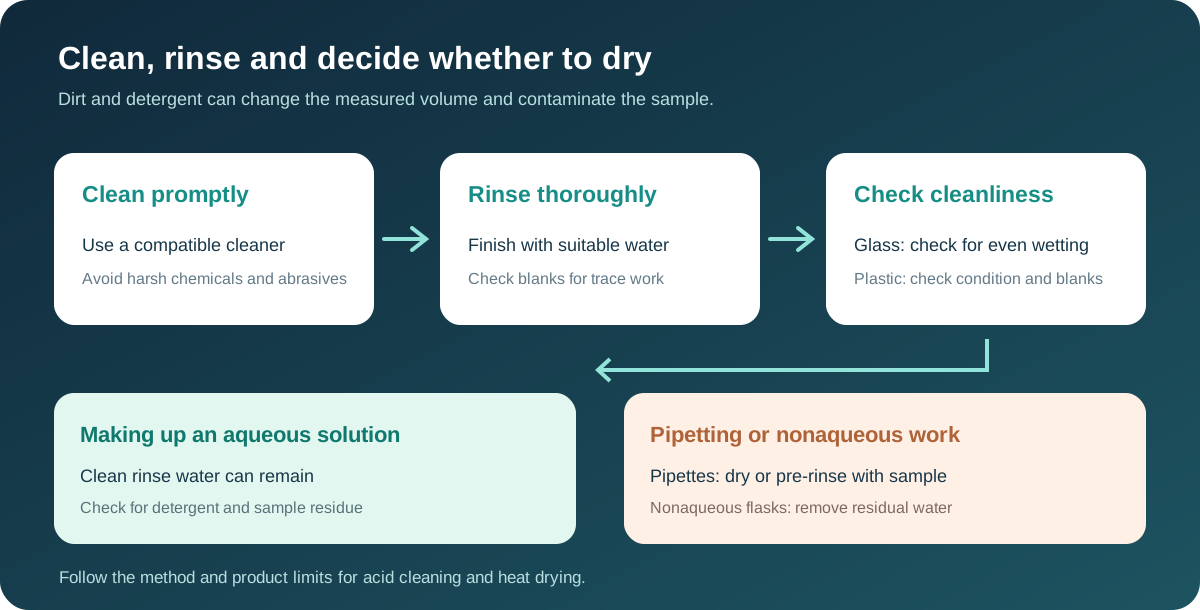
Oil or detergent residue can disrupt wetting, distort the meniscus and change how much liquid remains after a pipette drains. A clean glass surface generally wets evenly without beads of water. Empty the instrument safely after use, clean promptly, rinse thoroughly and select water of suitable quality for the final rinse. DWK glassware care · BRAND calibration procedure
↔ 表が見切れている場合は、左右にスクロールしてご覧ください。↔ Scroll the table horizontally to see any hidden columns.
| Previous contents or application | Cleaning approach | Final check |
|---|---|---|
| Routine aqueous solutions | Pre-rinse, wash with a compatible neutral to mildly alkaline lab detergent, then rinse thoroughly and finish with suitable purified water | No detergent residue and even wetting on glass |
| Oil or organic residues | Use a cleaner or solvent compatible with the instrument, including seals or bonded parts, and remove it thoroughly | Organic or solvent carryover and visible deposits |
| Trace metal analysis | Use the validated material- and analyte-specific cleaning procedure, then rinse with high-purity water | Vessel blank meets the method requirement |
| Plastic labware | Verify chemical resistance and use mild conditions within the product specification | Clouding, swelling, deformation and damaged markings |
Prolonged exposure to strong alkali, especially at elevated temperature, can attack glass. Avoid abrasive cleaners and tools that can damage the markings, wall or pipette tip. Use acid cleaning where the analytical method and material permit it. BRAND’s volumetric measurement guide · Choosing water for chemical analysis (Japanese)
When does volumetric labware need to be dry?
When making up an aqueous solution with water, a small amount of clean rinse water can remain in the flask. It becomes part of the specified final volume. For nonaqueous or moisture-sensitive work, remove residual water. For pipetting, either dry the instrument or pre-rinse it with the solution to be transferred, as appropriate. Discard the pre-rinse and keep it out of the stock bottle. Follow the method when sample volume is limited or contamination matters. Okayama University of Science practical guide
↔ 表が見切れている場合は、左右にスクロールしてご覧ください。↔ Scroll the table horizontally to see any hidden columns.
| Next use | Preparation | Error to prevent |
|---|---|---|
| Flask for aqueous make-up | Check rinse-water quality and absence of sample or detergent residue | Contamination in the standard |
| Flask for a nonaqueous or moisture-sensitive solution | Dry the flask and stopper by a compatible method | Changes to solvent composition or reaction conditions |
| Pipette for transferring a solution | Dry or pre-rinse with the solution as appropriate | Dilution by residual water |
| Labware for trace analysis | Protect from dust while drying and check blanks as needed | Contamination from storage or drying equipment |
Air-dry on a clean rack that allows drainage and protects against dust. Keep pipette tips clear of hard surfaces and avoid wiping the inside of the labware. Use the manufacturer’s temperature limits for oven drying, particularly with plastics, and let the labware cool before use. Avoid direct flames and hot plates. Corning, for example, gives an 80–90 °C upper range for drying volumetric glassware in its care guide. Corning glassware care · DWK plasticware care
Use a consistent measurement technique
- Read the markings. Check capacity, class, TC or TD, reference temperature, any specified drainage or waiting time, and the certificate identifier.
- Read the meniscus at eye level. Use the bottom of the concave meniscus for a typical clear aqueous solution. For coloured or opaque liquids, follow the specified reading method.
- Control temperature. Many instruments are marked at 20 °C. Check the instrument and let the solution and labware equilibrate before measuring.
- Inspect cleanliness and condition. Check for uneven wetting, scratches, chipped tips, faded markings and deformation.
- Check the effects on the sample. Adsorption, leaching and evaporation can matter as much as the instrument’s volume tolerance.
How to calibrate and set the next check
In gravimetric calibration, weigh the water contained or delivered and convert the mass to volume using the water temperature and the applicable corrections. Calibration establishes the realized volume and associated uncertainty. Routine checks can also include visual inspection and simple functional checks. ISO 4787:2021
On a certificate, check the instrument identifier, whether it was tested to contain or deliver, the volume tested, the reference temperature and the reported uncertainty. If the calibrated volume at the 100 mL mark is 99.94 mL, the calibrated volume minus nominal volume is −0.06 mL. Use the calibrated volume in calculations where appropriate. Apply the lab’s decision rule and consider the measurement uncertainty when assessing conformity.
↔ 表が見切れている場合は、左右にスクロールしてご覧ください。↔ Scroll the table horizontally to see any hidden columns.
| When to check | What to do |
|---|---|
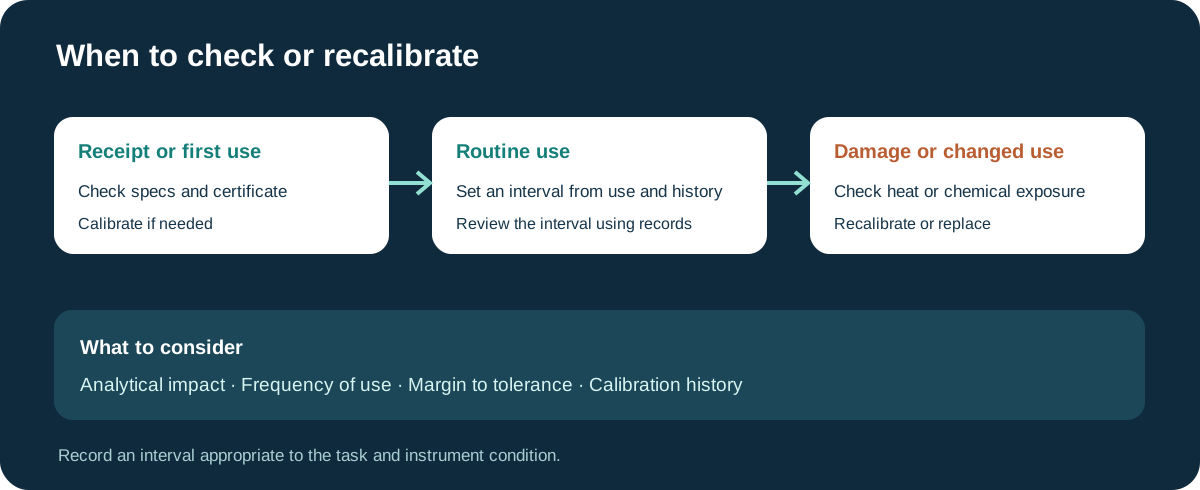
| Receipt or first use in a critical method | Review the specification and certificate, then calibrate individually if needed |
| Routine interval | Set or revise the interval from use frequency, analytical impact, past results and margin to tolerance |
| Drop, chip, damaged graduations or deformation | Remove from use and inspect, recalibrate or replace as appropriate |
| Aggressive cleaning, heating, autoclaving or chemical exposure | Inspect and recalibrate if capacity may have changed |
| A new use or tighter analytical requirement | Reassess the earlier result against the new requirement |
BRAND illustrates possible intervals of one to three years for glass labware and three to twelve months for plastic and liquid-handling instruments. Set the interval for your own use, condition and history, particularly for critical standard preparation and instruments close to a tolerance limit. BRAND’s volumetric measurement guide · Calibration intervals (Japanese) · Metrological traceability (Japanese)
Examples from an analytical laboratory
↔ 表が見切れている場合は、左右にスクロールしてご覧ください。↔ Scroll the table horizontally to see any hidden columns.
| Application | Selection |
|---|---|
| Prepare a 10 mg/L standard from a 100 mg/L stock for inductively coupled plasma optical emission spectrometry (ICP-OES) | Transfer 10 mL with a single-volume pipette and make up to 100 mL in a volumetric flask. Check calibration and vessel blanks |
| Dilute an HF-containing digest for inductively coupled plasma mass spectrometry (ICP-MS) | Select compatible plastic labware. Verify tolerance, trace-metal blanks and recovery |
| Add approximately 80 mL of water to a mobile-phase mixture | Use a graduated cylinder if the procedure permits an approximate amount. When precise composition is required, use the method’s specified volumetric or gravimetric preparation |
| Prepare a series with several small aliquot volumes | Compare the graduated pipette’s performance at each volume with capacity-specific pipettes or calibrated dispensers |
Frequently asked questions
What is the difference between a volumetric flask and a volumetric pipette?
The flask sets the final volume. The pipette transfers a fixed aliquot. For a tenfold dilution, transfer 10 mL of stock with the pipette, then make the total solution up to 100 mL in the flask.
What if I fill a volumetric flask above the mark?
Remake the solution if the specified concentration is required. Removing a portion after mixing removes solute as well as solvent, so the concentration stays below the intended value.
Can a graduated cylinder be used in quantitative analysis?
Yes, when the actual tolerance and calibration satisfy the method requirement. A volumetric flask is usually the first choice for the final volume of a calibration standard.
Does Class A glassware need calibration?
The class identifies a tolerance. Use the required accuracy, condition and calibration history to decide whether you need individual calibration or a routine check.
Is plastic labware less accurate than glass?
Compare the stated tolerances and calibration results at the same volume and reference conditions. For plastic, check how heating, cleaning and chemical exposure affect the product.
Must a rinsed volumetric flask be completely dry?
For aqueous make-up, a little clean rinse water can count toward the final volume. For nonaqueous or moisture-sensitive preparation, remove it first.