
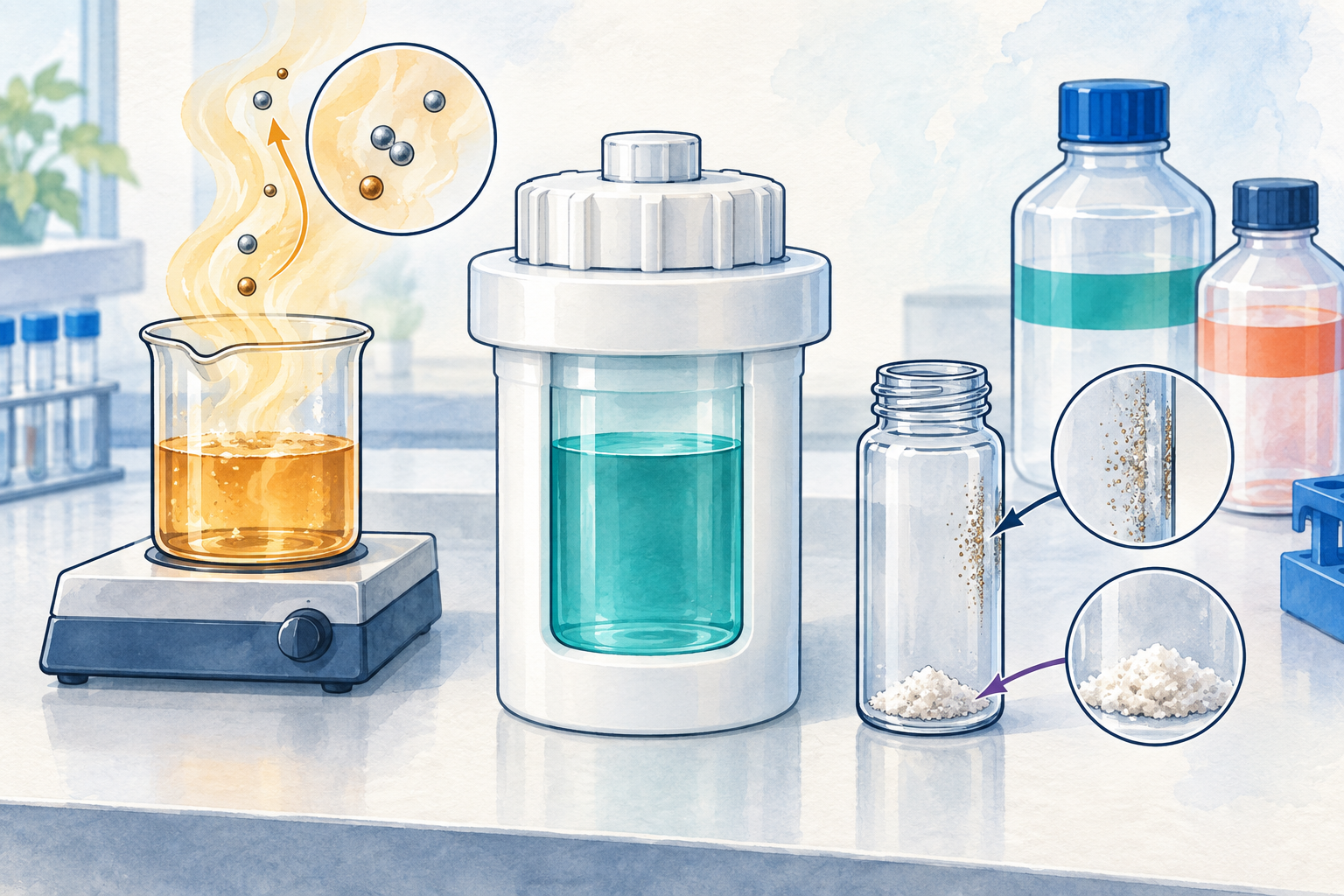
When elemental analysis gives poor recovery, look at what happened between sampling and measurement. An analyte can adsorb onto a vessel, escape to the gas phase during heating, or precipitate as a sparingly soluble compound. A solid residue may also retain analyte if digestion was incomplete.
This guide covers wet preparation for inductively coupled plasma mass spectrometry (ICP-MS) and inductively coupled plasma optical emission spectrometry (ICP-OES). Consider the analyte's chemical form, oxidation state, acid composition, matrix, temperature and vessel configuration together. Use the applicable analytical method, equipment limits and laboratory safety procedures when setting preparation conditions.
Distinguish four mechanisms
↔ 表が見切れている場合は、左右にスクロールしてご覧ください。↔ Scroll the table horizontally to see any hidden columns.
| Mechanism | What happens | What to check |
|---|---|---|
| Adsorption | Dissolved analyte transfers to the vessel wall or adhering particles | Compare storage times and vessel materials. Analyze a suitable vessel rinse |
| Volatilization | The element or a compound enters the gas phase and can escape | Compare results before and after open heating, concentration or evaporation to dryness |
| Precipitation or coprecipitation | A solid forms and removes analyte from the solution | Check when cloudiness formed and compare the supernatant and solid fraction |
| Contamination | Vessels, reagents, tools or the environment contribute analyte | Investigate high procedural blanks and differences between vessel or reagent lots |
Record when solids appear. Material that never dissolved during digestion needs a different investigation from a precipitate that formed during cooling or dilution.
Volatilization depends on chemical form and preparation conditions
Mercury: Reduction, deposition and volatilization
Mercury (Hg) can be reduced to elemental mercury at active sites on vessel walls or particles. It can then deposit on surfaces or enter the headspace. The US Environmental Protection Agency (EPA) distinguishes between permanganate treatment in a particular preparation for cold-vapor atomic absorption (CVAA) and stabilization for ICP measurements. For the ICP procedures discussed in its guidance, EPA advises against permanganate addition and gives an example of gold stabilization under acidic conditions. Verify compatibility with the method, blanks and instrument before adopting an additive. EPA SW-846 inorganic-analysis guidance
Compare open and closed preparation where permitted. Check the oxidation state, vessel lid, seals, tubing and spray chamber, and monitor whether concentrations change before analysis. Use a rinse blank after a high-concentration sample to check carryover and washout.
Selenium: Open concentration and evaporation to dryness
In an open-vessel study of nitric acid (HNO₃) and nitric acid–hydrofluoric acid (HF) digestions, selenium (Se) losses after evaporation to complete dryness depended on the levels of calcium, magnesium and phosphate in the sample. Recovery from a simple standard solution may differ from recovery in the sample matrix. Where the method allows it, compare preparation without drying and closed-vessel digestion, using representative samples, pre-digestion spikes or certified reference materials. Open-vessel stability study indexed in EPA HERO
Antimony: Open heating in chloride-containing solutions
A published digestion procedure warns that boiling or evaporating to dryness can cause losses, particularly for antimony (Sb) in a hydrochloric acid (HCl) medium. Some methods use HCl to dissolve or stabilize analytes. Under the specified method conditions, check open heating time, volume reduction and any evaporation to dryness or use of a lid. EPA-hosted digestion procedure
Arsenic and cadmium: Check the conditions before assigning a loss mechanism
Arsenic (As) can form volatile species, but the cited open-vessel study did not observe significant instability for As or cadmium (Cd) under the tested conditions. Identify the potential species and the redox conditions in your own preparation when considering volatilization. Open-vessel stability study indexed in EPA HERO
Acid composition and precipitation
Hydrochloric acid and silver
Residual chloride can cause silver (Ag) to precipitate as silver chloride (AgCl). EPA Method 3052 calls for thorough rinsing after HCl vessel cleaning to avoid Ag precipitation. At high chloride concentrations, soluble chloro complexes can change the behavior. Verify recovery under the actual analyte concentration, acid composition, temperature and matrix. EPA Method 3052
Hydrofluoric acid and aluminum, calcium or magnesium
HF helps dissolve silicates. Fluoride left in the digest can form sparingly soluble metal fluorides and attack quartz components. One soil study reported low recovery of aluminum (Al), calcium (Ca) and magnesium (Mg) after nitric acid–HF digestion, with improvement after heating following boric acid addition under the study conditions. Soil recovery study indexed in EPA HERO
EPA Method 3052 describes boric acid complexation of fluoride and the option of an HF-resistant introduction system. Boric acid addition prevents determination of boron from that preparation and can cause cloudiness, high salt content or viscosity changes. If evaporation is proposed to reduce residual acid, verify analyte retention and check for precipitation as the composition changes. EPA Method 3052, Sections 7.3.9–7.3.10
Strong nitric acid digestion and antimony or tin
Vigorous digestion with concentrated nitric acid can result in sparingly soluble oxides of Sb and tin (Sn). Check the element-specific procedure and analyze the residue or vessel rinse when poor recovery persists. If filtering, verify membrane and solvent compatibility as well as analyte retention. EPA material on 40 CFR Part 136 procedures
Sulfuric acid and barium, lead, strontium or calcium
Sulfuric acid (H₂SO₄) can lead to sparingly soluble barium or lead sulfates. Strontium and calcium sulfates may also precipitate, depending on conditions. Inspect for solids after cooling and dilution. If the original sample contained a refractory mineral such as barium sulfate, investigate incomplete dissolution as well as new precipitation. Multi-Agency Radiological Laboratory Analytical Protocols Manual (MARLAP), separation techniques
Choose the vessel for its role in the procedure
↔ 表が見切れている場合は、左右にスクロールしてご覧ください。↔ Scroll the table horizontally to see any hidden columns.
| Vessel material | Typical reason to consider it | What to verify |
|---|---|---|
| Perfluoroalkoxy polymer (PFA) or polytetrafluoroethylene (PTFE) | Fluoropolymer configurations can support HF digestion or closed microwave digestion | Rating of the specific vessel and seal, service history, blanks and adsorption or deposition |
| Polypropylene (PP) or polyethylene (PE) | Lightweight, break-resistant containers for many acidified aqueous samples | Heat rating, deformation, permeation, adsorption and blanks from additives or previous use |
| Quartz | High-temperature configurations and some closed-system mercury applications | Compatibility with HF, phosphoric acid and strong alkalis, and the silicon blank |
| Borosilicate glass | Visual inspection and storage of suitable acidified solutions | HF attacks glass. Check vessel contribution to low-level boron and silicon measurements |
In some applications, acidifying to a pH below 1 can reduce adsorption. Verify this approach against the preservation method and analyte chemistry. A digestion vessel, storage bottle, volumetric flask and autosampler vial have different requirements for temperature, sealing, cleanliness and volume. MARLAP, sample preparation
Evaluate the acid system against four requirements
- Decompose the matrix by oxidizing organic material or dissolving metals, oxides or silicates as needed.
- Keep the analyte in solution by managing hydrolysis, adsorption and precipitation.
- Control formation of volatile species through redox and vessel conditions.
- Verify compatibility with the instrument, including residual acid, salts, viscosity, dissolved solids and spectral interference.
An acid can help with one requirement and complicate another. HCl can aid dissolution or stabilization while introducing chloride interferences or AgCl precipitation. HF can dissolve silicates while leaving fluoride that affects recovery and limits the materials used in sample introduction.
Design a comparison that can locate the loss
1. Fix the analytical requirements
Define the target elements, reporting limit, concentration range, matrix and sample fraction, such as total, total recoverable or leachable content. Identify the method conditions you are allowed to vary and the acid and dissolved-solid limits of the introduction system.
2. Pair each hypothesis with a check
↔ 表が見切れている場合は、左右にスクロールしてご覧ください。↔ Scroll the table horizontally to see any hidden columns.
| Analyte | Possible mechanism | Useful comparison |
|---|---|---|
| Hg | Reduction, volatilization and surface deposition | Open versus closed preparation, validated stabilization and time after digestion |
| Se | Loss during open concentration or drying | Preparation with and without drying, closed versus open digestion, and representative matrices |
| Sb | Loss in heated HCl or formation of a poorly soluble species in nitric acid | Acid composition, heating conditions, residues and spike timing |
| Ag | Chloride precipitation | Chloride carryover from cleaning and the distribution between solution and solid |
| Al, Ca and Mg | Fluoride formation after HF digestion | Fluoride complexation and residual solids under the applicable equipment and method conditions |
| Ba, Pb, Sr and Ca | Sulfate precipitation | Acid composition, cloudiness after cooling or dilution, and analysis of the solid fraction |
3. Compare pre- and post-preparation spikes
↔ 表が見切れている場合は、左右にスクロールしてご覧ください。↔ Scroll the table horizontally to see any hidden columns.
| Test | What it helps examine |
|---|---|
| Spike before preparation | Overall recovery through preparation and measurement |
| Spike after preparation | Response in the final matrix, including measurement-stage effects |
| Analyze a vessel rinse | Analyte that remained on a vessel surface |
| Process residue separately | Analyte retained in undissolved or newly formed solids |
Low recovery for the pre-preparation spike with good recovery for the post-preparation spike points toward a preparation loss. The spike can have a different chemical form or binding state from the analyte in the sample, so use additional evidence to assess digestion completeness.
4. Combine blanks and reference materials
Vessel, reagent and full procedural blanks help identify the source of contamination. Use a certified reference material with a comparable matrix and concentration when available. After cleaning fluoropolymer vessels, check both the blank and any effects of residual cleaning acid on recovery, especially for Ag after HCl cleaning. EPA Method 3052
5. Check stability until measurement
Compare appearance, concentration, internal standard response and blanks at times representative of routine work. Adsorption, precipitation or volatilization may occur after digestion. Keep the comparison within prescribed storage conditions and holding times.
6. Define acceptance criteria in advance
Set criteria for recovery, repeatability, blanks, residues, stability and carryover before looking at the results. Document when a result is excluded, when the test must be repeated and which samples the findings apply to.
Troubleshoot from the observed symptom
↔ 表が見切れている場合は、左右にスクロールしてご覧ください。↔ Scroll the table horizontally to see any hidden columns.
| Observation | First checks |
|---|---|
| Low only after open heating | Volatilization, splashing, drying and material left on vessel walls |
| Acceptable immediately after digestion but low the next day | Adsorption, precipitation, acid concentration and oxidation state |
| Clear solution with poor recovery | Adsorption, volatilization, fine particles and differences in chemical form |
| Cloudiness appears after cooling | Fluoride or sulfate formation, salt concentration and temperature |
| Only Ag drops after HCl cleaning | Residual chloride and AgCl formation |
| Al, Ca or Mg drops after HF digestion | Fluoride complexation and analyte in residual solids |
| Slow Hg washout | Elemental mercury, deposits in the introduction system and stabilization conditions |
| Result rises after changing vessels | Adsorption in the old vessel or additional contamination from the new one |
Document the proposed loss mechanism, the conditions you compared, the acceptance criteria and the range of samples covered. Follow the laboratory's approved procedures for acid digestion, HF and heated pressurized vessels.