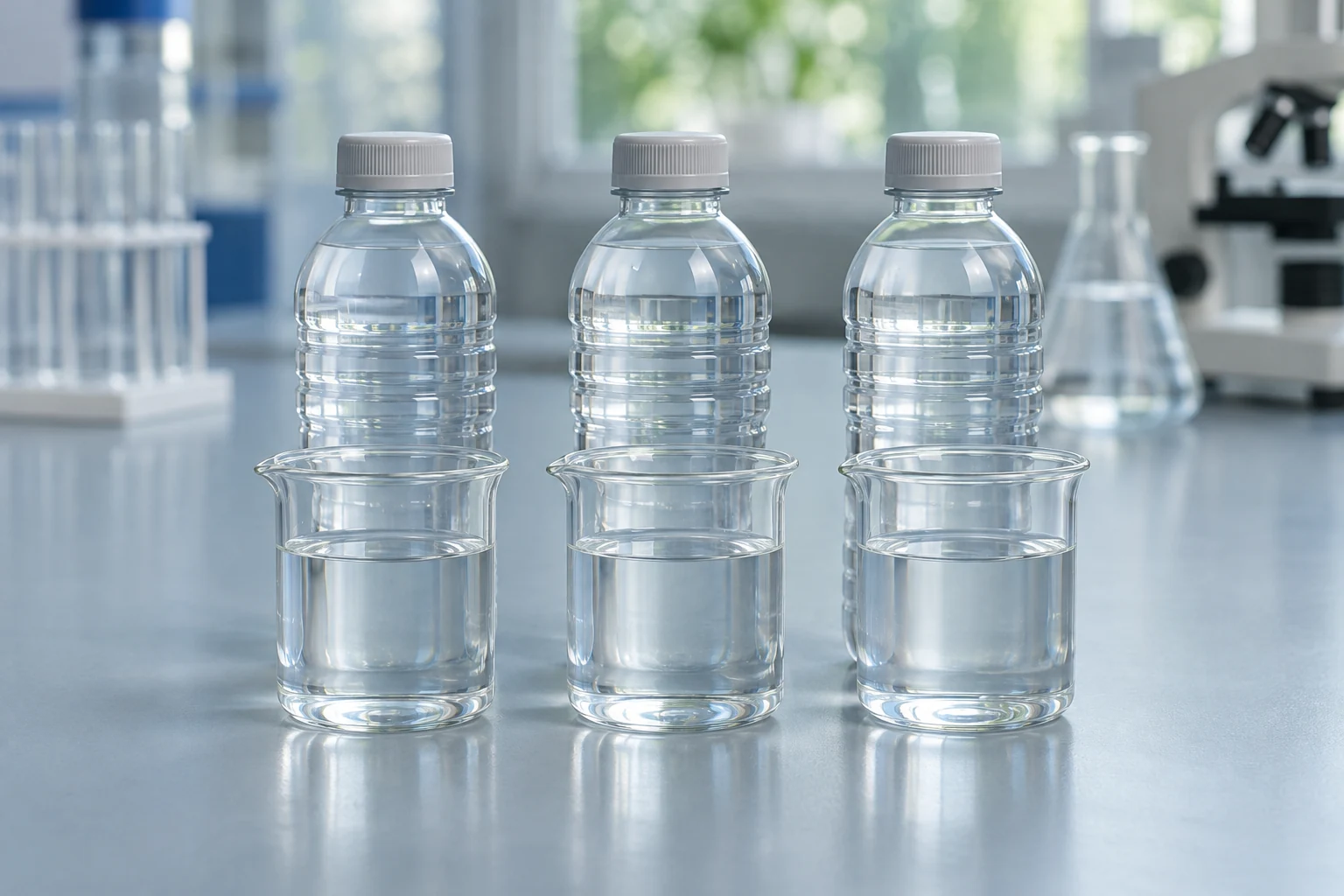
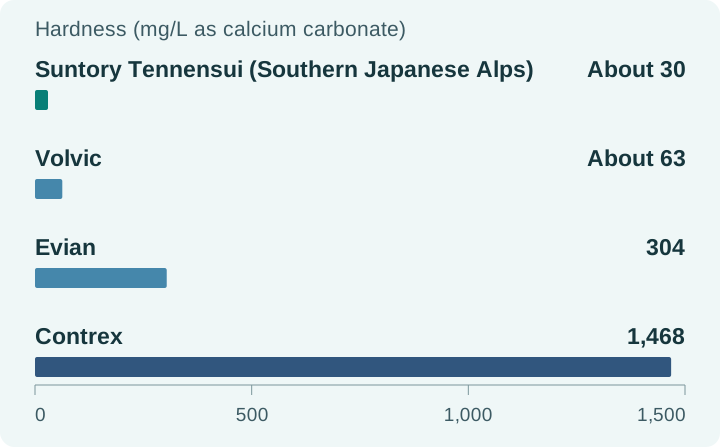
Suntory Tennensui ranges from about 10 to 80 mg/L in hardness depending on the source, compared with 304 mg/L for Evian and 1,468 mg/L for Contrex. Water hardness mainly reflects how much dissolved calcium and magnesium the water contains. The table below compares 12 examples on the same scale. A study of public drinking water in 314 Chinese cities shows why hardness can vary widely within a country.
Mineral water hardness chart
Hardness is reported in milligrams per litre as calcium carbonate. The table is sorted by hardness. Products sold under the same brand can have different values if they come from different sources.
↔ 表が見切れている場合は、左右にスクロールしてご覧ください。↔ Scroll the table horizontally to see any hidden columns.
| Product | Source or country of origin | Hardness (mg/L as calcium carbonate) |
|---|---|---|
| Suntory Tennensui | Northern Japanese Alps, Japan | About 10 |
| Suntory Tennensui | Oku-Daisen, Japan | About 20 |
| Hita Tenryosui | Hita, Oita, Japan | About 27 |
| I LOHAS Natural Mineral Water | Hakushu, Yamanashi, Japan | 27 |
| Suntory Tennensui | Southern Japanese Alps, Japan | About 30 |
| Asahi Oishii Mizu Fuji Vanadium Natural Water | Mount Fuji area, Japan | About 30 |
| Asahi Oishii Mizu Rokko Natural Water (600 mL) | Rokko, Japan | About 40 |
| Volvic (UK product information) | France | About 63 (calculated) |
| I LOHAS Natural Mineral Water | Aso, Kumamoto, Japan | 71.1 |
| Suntory Tennensui | Aso, Japan | About 80 |
| Evian (Ito En, 330 mL) | France | 304 |
| Contrex | France | 1,468 |
The figures are published by the manufacturers or distributors. The value for Volvic was calculated from its UK product information, which lists 12 mg/L calcium and 8 mg/L magnesium. Check the source and mineral composition on the label of the specific bottle you are comparing. Suntory · Hita Tenryosui · Coca-Cola Japan · Asahi Beverages nutrition information · Asahi Rokko product information · Volvic UK · Ito En · Contrex Japan
Is drinking water in China hard?
Public drinking water in China varies in hardness. A study of samples from 314 cities found substantial regional differences in calcium and magnesium concentrations, including low-hardness supplies in southern China. The researchers linked these differences to factors including climate and interactions between water and rock. Peng et al., study of public drinking water in China
↔ 表が見切れている場合は、左右にスクロールしてご覧ください。↔ Scroll the table horizontally to see any hidden columns.
| Component | Range in sampled water (mg/L) | Mean concentration (mg/L) |
|---|---|---|
| Calcium | 2.5–155.1 | 40.4 |
| Magnesium | 0.2–81.9 | 12.4 |
These mean concentrations give an estimated hardness of about 152 mg/L as calcium carbonate for the study samples. The study examined public drinking water from sampled cities. Bottled mineral waters have their own source profiles. Since each mineral's range was reported separately, the two highest concentrations may have come from different samples. To check water in a particular city, use the local water supplier's data. For a bottled product, use the source and composition on the label.
What counts as soft or hard water?
Hardness mainly reflects dissolved calcium and magnesium ions. The U.S. Geological Survey (USGS) uses the following guidelines. On this scale, water with a hardness of 32 mg/L is soft. USGS water hardness guidance
↔ 表が見切れている場合は、左右にスクロールしてご覧ください。↔ Scroll the table horizontally to see any hidden columns.
| Hardness (mg/L as calcium carbonate) | USGS description |
|---|---|
| 0–60 | Soft |
| Above 60 through 120 | Moderately hard |
| Above 120 through 180 | Hard |
| Above 180 | Very hard |
Japanese product descriptions often use around 100 mg/L as the threshold for soft water. A product labelled soft in Japan at 80 mg/L falls in the moderately hard category on the USGS scale. Compare the stated concentration when descriptions use different thresholds. Mineral Water Association of Japan · Suntory product guidance
Which hardness values does Hita Tenryosui publish?
Hita Tenryosui gives about 27 mg/L in its Japanese frequently asked questions and about 32 mg/L on its Chinese-language product introduction. Both figures fall in the soft category on the USGS scale. The comparison table uses the Japanese figure. Check the label for the specific product you have. Japanese FAQ · Chinese-language product introduction
Where does Premium Water come from, and how hard is it?
The Japanese supplier lists 25 mg/L for Fujiyoshida, 59 mg/L for Gifu Kitagata and 36 mg/L for Minami-Aso. All three are soft on the USGS scale. The source of a particular delivery is shown on the bottle or outer box. Premium Water source and composition table · Source FAQ
How to calculate water hardness from a bottle label
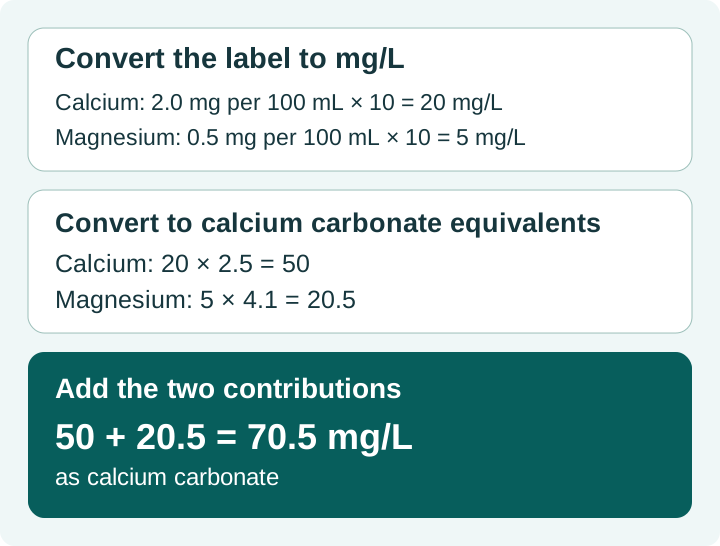
If hardness is missing from the label, convert the listed calcium and magnesium concentrations to mg/L. For quantities given per 100 mL, multiply each by 10.
Hardness (mg/L as calcium carbonate) ≈ 2.5 × calcium (mg/L) + 4.1 × magnesium (mg/L)
For example, a bottle that lists 2.0 mg of calcium and 0.5 mg of magnesium per 100 mL contains 20 mg/L and 5 mg/L, respectively. The estimated hardness is 2.5 × 20 + 4.1 × 5 = 70.5 mg/L, or about 71 mg/L. Expressing both contributions as calcium carbonate equivalents puts them on the same basis. Sodium, potassium and silica are outside this calculation. Suntory's hardness formula
Ito En lists 8.0 mg of calcium and 2.6 mg of magnesium per 100 mL for Evian. These label values give an estimate of about 307 mg/L using the rounded factors above. The same product page lists a hardness of 304 mg/L. Estimates can differ from the reported value because the label values and conversion factors are rounded. Use the published hardness where available. Ito En Evian product information
Why hardness varies with the source
Rainwater can pick up calcium and magnesium as it passes through soil and rock. Local geology, time spent underground and the choice of surface water or groundwater can all affect hardness. Tokyo Metropolitan Government Bureau of Waterworks
- Japan. Suntory's four sources illustrate the differences within one brand. A separate example from the Tokyo water utility shows tap water averaging about 60 mg/L, with values of 25.3–87.6 mg/L across sampled locations in fiscal year 2023. Suntory source values · Tokyo water utility
- Europe. Chalk and limestone contribute to hard water in parts of south-east England. The three French brands in the table illustrate the variation between individual bottled waters. Thames Water
- United States. The USGS reports harder groundwater in parts of the east-central and western United States. For tap water at a specific address, consult the local supplier's data. USGS regional overview
What hardness changes in everyday use
↔ 表が見切れている場合は、左右にスクロールしてご覧ください。↔ Scroll the table horizontally to see any hidden columns.
| Situation | What to look for |
|---|---|
| Drinking water or brewing tea | Mineral composition can affect mouthfeel and the taste of a brew. Waters with the same hardness can have different proportions of calcium, magnesium and other dissolved constituents. |
| Boiling water in a kettle | Calcium carbonate can precipitate during heating and form white scale. The amount also depends on bicarbonate and heating conditions. |
| Washing with soap | Calcium and magnesium can react with soap to form deposits and reduce lather. |
White deposits are a clue to water chemistry. To find the hardness value, refer to a water-quality report or a measurement. USGS guidance on scale and soap
The World Health Organization (WHO) has no health-based guideline value for hardness in drinking water. Assessing whether a water supply is safe also requires information about microorganisms and specific chemical contaminants. WHO drinking-water fact sheet on hardness
Related reading
- How water hardness affects coffee and tea (Japanese) explains how water composition can change extraction and taste.
- Purified vs ultrapure water for laboratory use explains how laboratories check impurities and analytical blanks.