
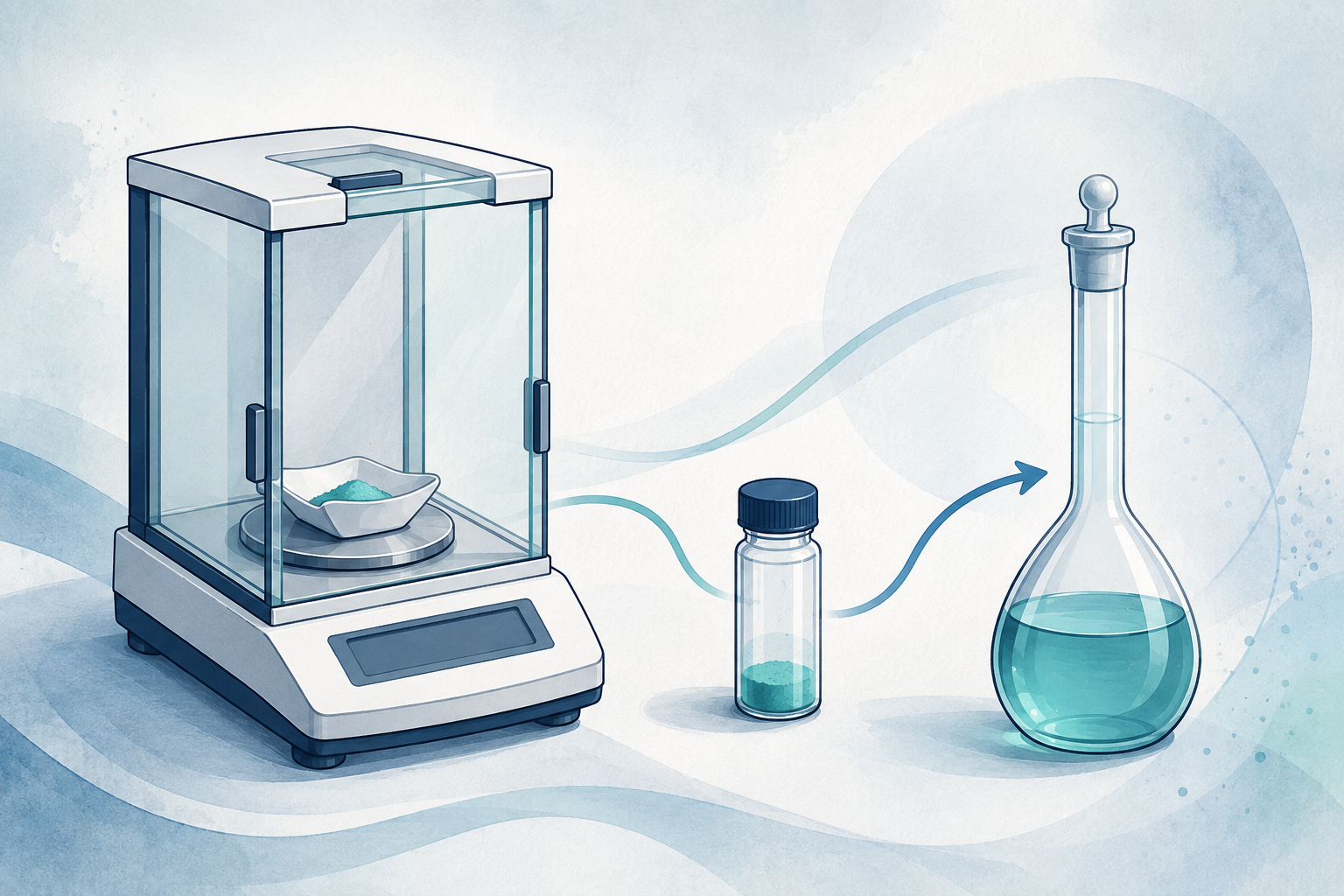
To convert the concentration measured by inductively coupled plasma (ICP) spectrometry to the concentration in the original sample, reverse any additional dilution, multiply by the final volume to obtain the analyte mass, and divide by the mass of sample weighed. The units µg/L and mg/kg describe different quantities.
For example, a result of 2 µg/L can correspond to different sample concentrations depending on whether you prepared 0.1 g or 1 g of material. The preparation volume and the dilution after preparation also matter. The worked examples below use illustrative data.
Identify what the instrument result represents
This guide covers samples that are weighed, digested or extracted, brought to a known volume, and diluted further if needed. The calculation starts from the concentration in the solution introduced to the instrument, before additional dilution correction or conversion to the original sample basis.
↔ 表が見切れている場合は、左右にスクロールしてご覧ください。↔ Scroll the table horizontally to see any hidden columns.
| Value available | What it represents | Calculation still needed |
|---|---|---|
| Concentration in the measured solution | Concentration in the solution introduced to the instrument | Reverse additional dilution and use the final volume and sample mass |
| Dilution-corrected concentration | Concentration in the solution made up after digestion or extraction | Use the final volume and sample mass |
| Concentration in the original sample | Analyte mass per unit mass of sample | Confirm the reporting basis and use the result from that stage |
The calculator takes the first type of value. If the instrument software has fields for sample mass or dilution, check the output column definition and the active correction settings before copying the result.
Conversion equation
↔ 表が見切れている場合は、左右にスクロールしてご覧ください。↔ Scroll the table horizontally to see any hidden columns.
| Symbol | Input | Unit |
|---|---|---|
| C | Concentration in the measured solution | µg/L |
| B | Blank value eligible for subtraction | µg/L |
| D | Additional dilution factor after making up to the final volume | Dimensionless |
| V | Final volume after digestion or extraction | mL |
| m | Mass of sample weighed | g |
Sample concentration (mg/kg) = (C − B) × D × (V ÷ 1000) ÷ m
Dividing V by 1000 converts millilitres to litres. Multiplying µg/L by litres gives µg of analyte. Dividing by the sample mass in grams gives µg/g, numerically equal to mg/kg.
Why µg/g and mg/kg have the same numerical value
One microgram is 0.001 mg and one gram is 0.001 kg. Converting numerator and denominator by the same factor preserves the ratio.
1 µg/g = 0.001 mg ÷ 0.001 kg = 1 mg/kg
For a concentration in µg/L, track the denominator in three steps: solution concentration in µg/L, analyte mass in µg, and sample concentration in µg/g. This makes a factor-of-1000 error easier to spot.
Set B to zero when no blank subtraction applies. Use a blank on the same concentration basis as the result, and subtract it only if the analytical method permits it.
Worked example: 0.1523 g brought to 50 mL
Suppose the sample mass is 0.1523 g, the final volume is 50 mL, the additional dilution is tenfold, the measured concentration is 2.35 µg/L and the applicable blank is 0.05 µg/L.
- Subtract the blank: 2.35 − 0.05 = 2.30 µg/L.
- Reverse the additional dilution: 2.30 × 10 = 23.0 µg/L.
- Obtain the analyte mass: 23.0 × 0.050 = 1.15 µg.
- Divide by the weighed sample mass: 1.15 ÷ 0.1523 ≈ 7.550886 µg/g.
To three significant figures, the result is 7.55 µg/g = 7.55 mg/kg. Retain unrounded values through the calculation.
The 1.15 µg represents the analyte in the full 50 mL preparation. Even if the instrument measures only an aliquot, the full volume can be used to recover the total analyte mass when the solution is homogeneous.
Check the conversion in reverse
7.550886… µg/g × 0.1523 g ÷ 0.050 L ÷ 10 + 0.05 µg/L = 2.35 µg/L
The reverse calculation checks the arithmetic and units. The weighing and preparation records still need to be checked, because an incorrect mass used in both directions will cancel out.
Example without additional dilution or blank subtraction
A 0.2500 g sample is brought to 25.0 mL and measured directly at 8.00 µg/L. Enter 1 for the additional dilution factor and leave the blank field empty.
8.00 × 1 × 0.0250 ÷ 0.2500 = 0.800 mg/kg
Even when the dilution factor is 1, conversion still requires the final preparation volume and sample mass.
Convert each independently prepared replicate before averaging
Calculate each sample using its own preparation conditions.
↔ 表が見切れている場合は、左右にスクロールしてご覧ください。↔ Scroll the table horizontally to see any hidden columns.
| Sample | Mass (g) | Final volume (mL) | Additional dilution | Measured (µg/L) | Blank (µg/L) | Result (mg/kg) |
|---|---|---|---|---|---|---|
| 1 | 1 | 100 | 1 | 10 | None | 1.00 |
| 2 | 0.5 | 50 | 2 | 6.5 | 1 | 1.10 |
| 3 | 0.2 | 20 | 5 | 2 | 0.2 | 0.900 |
Calculate each result as Rᵢ = (Cᵢ − Bᵢ) × Dᵢ × (Vᵢ ÷ 1000) ÷ mᵢ. For sample 2, (6.5 − 1) × 2 × 0.050 ÷ 0.5 gives 1.10 mg/kg. The unweighted arithmetic mean of the three results is 1.00 mg/kg. The sample standard deviation (SD) is 0.100 mg/kg and the relative standard deviation (RSD) is 10.0%. The sample SD uses n − 1 in the denominator.
Average independently prepared replicates that represent the same original material, analyte and reporting basis. The preparation conditions can differ, so averaging the solution concentrations before conversion can give a different result.
When results differ by a factor of ten
Consider a 0.500 g sample brought to 50.0 mL, diluted tenfold, and measured at 2.00 µg/L. The applicable blank on that basis is 0.200 µg/L. The calibration standard factor is 1.
(2.00 − 0.200) × 10 × 0.0500 ÷ 0.500 = 1.80 mg/kg
↔ 表が見切れている場合は、左右にスクロールしてご覧ください。↔ Scroll the table horizontally to see any hidden columns.
| Stage represented by the inputs | C and B | Additional factor to apply | Result |
|---|---|---|---|
| Measured solution | C = 2.00, B = 0.200 µg/L | 10 | 1.80 mg/kg |
| Preparation after reversing the tenfold dilution | C = 20.0, B = 2.00 µg/L | 1 | 1.80 mg/kg |
| The factor is mistakenly applied a second time | C = 20.0, B = 2.00 µg/L | 10 | 18.0 mg/kg |
Both the sample result and the blank must be expressed at the same stage. The calculator takes the first row; the second row is a manual cross-check. Record the output column, units, instrument correction settings and preparation history together.
Recover the measured concentration
With the same inputs, C = R × m ÷ [D × (V ÷ 1000)] + B. In this example, 1.80 × 0.500 ÷ (10 × 0.0500) + 0.200 gives 2.00 µg/L.
What to retain with the calculation
- Sample ID, weighing record, final volume and the aliquot and volume for each additional dilution.
- Instrument output column and unit, whether dilution was already applied, and the blank type and basis for subtraction.
- Individual results and unrounded intermediate calculations. For replicate statistics, retain the replicate IDs and n.
The ICP sample concentration calculator returned 1.80 mg/kg and an analyte mass of 0.900 µg for the first row in the Japanese article's check on 19 October 2026. These figures demonstrate the calculation.
Confirm the reporting basis and preparation scope
The calculation uses the sample mass entered. Dry-mass reporting, moisture adjustment, recovery correction and verification of digestion completeness require separate decisions. Whether a result represents total content or an extractable fraction depends on the sample preparation. State the method or extraction conditions when they are needed to interpret the result. US Environmental Protection Agency (EPA) Method 6020B, Section 1.1
If an original liquid sample was measured by volume and must be reported in mg/L, use the method's volume-based equation. The calculator's sample mass field expects grams.
Use the calculator with the laboratory record
Enter the number of independently weighed and prepared samples, then enter the five inputs for each one. The calculator shows individual concentrations, mean, sample SD, RSD and the intermediate steps. When adding replicate cards, the final volume, additional dilution and blank can be carried forward. Verify sample mass and measured concentration for each card and change any preparation settings that differ. The on-screen results use three significant figures; choose reporting precision using the applicable method or laboratory procedure.
Frequently asked questions
Does the equation differ between ICP-MS and ICP-OES?
The unit conversion is the same for inductively coupled plasma mass spectrometry (ICP-MS) and inductively coupled plasma optical emission spectrometry (ICP-OES) when both results describe the measured solution in µg/L and use the same preparation basis. Calibration and interference correction are specific to the measurement method.
What if blank subtraction gives a negative number?
The calculator displays the negative result. Check how the analytical method defines detection and reporting before assigning a value of zero or a non-detect.
What if the final volume is unknown?
Check the preparation record; the solvent added is not necessarily the final volume. For a method that does not use a make-up volume, follow its prescribed quantities and calculation.