

Plastics can warp, shrink or bend well below their melting points. One polypropylene (PP) grade melts at 160 °C (320 °F), yet its heat deflection temperature under higher test stress is 55 °C (131 °F). A recycled polyethylene terephthalate (PET) sample had a melting peak near 250 °C (482 °F). The resin, part thickness, load and heating time all affect when a product loses its shape. PP grade data · PET measurements
The melting temperature (Tₘ) describes melting of crystalline regions. The glass transition temperature (Tg) helps explain softening, and the heat deflection temperature (HDT) compares how specimens bend under a specified load. If you have measured Tg and Tₘ, use the reference tool to find candidate materials. Polymer Tg and melting point lookup
Melting points of PP, PET, polyethylene and nylon
The table gives examples from individual grades and measured samples. Check the grade and thermal history when comparing values. For a finished part, use its own service conditions and product guidance.
↔ 表が見切れている場合は、左右にスクロールしてご覧ください。↔ Scroll the table horizontally to see any hidden columns.
| Plastic | Example melting temperature | Grade or sample |
|---|---|---|
| High-density polyethylene (HDPE) | About 136 °C | Peak in the first heating run of an unblended recycled HDPE sample. Study |
| PP | 160 °C and 165 °C | Values for two homopolymer grades. LyondellBasell 3486-01 · TotalEnergies 3865 |
| Nylon 6 (polyamide 6, PA6) | 220 °C | BASF Ultramid B36 L. Grade data |
| PET | About 250 °C | Peak in the first heating run of an unblended recycled PET sample. Study |
When comparing results from differential scanning calorimetry (DSC), check whether the reported value is the melting peak or the onset. Heating rate and sample history also matter. Amorphous plastics such as polystyrene (PS), poly(methyl methacrylate) (PMMA) and conventional acrylonitrile–butadiene–styrene (ABS) grades generally lack a distinct crystalline melting peak. Their glass transitions help explain changes in stiffness. ISO 11357-3:2025, DSC melting and crystallisation
Do plastics have a boiling point? Under ordinary heating, many plastics decompose before their long polymer chains could vaporise intact. Small molecules can be released as the chains break down. Gas evolution can therefore indicate decomposition. National Institute of Standards and Technology (NIST) report on polymer degradation
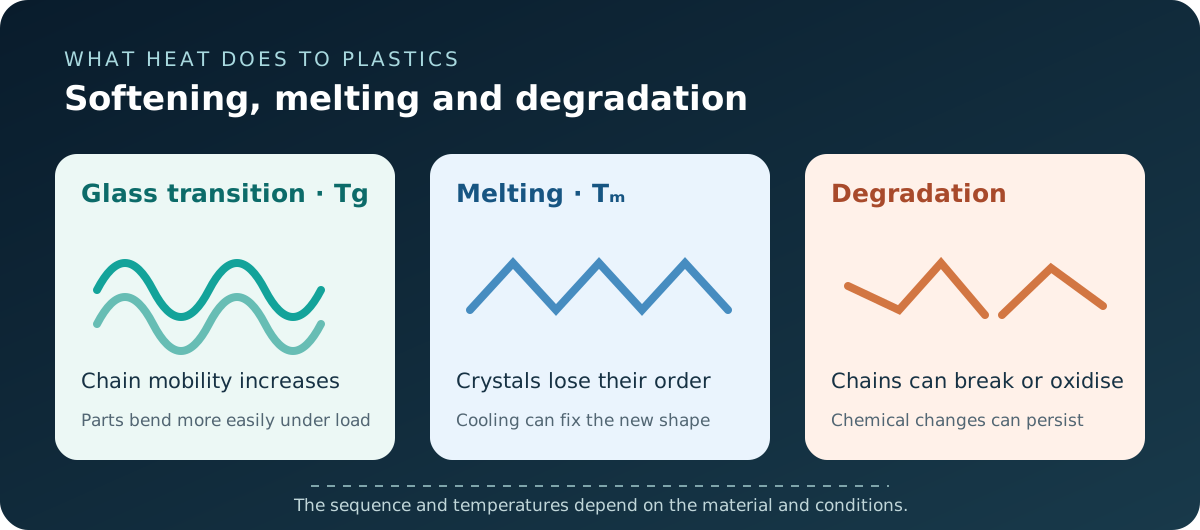
Softening, melting and degradation
↔ 表が見切れている場合は、左右にスクロールしてご覧ください。↔ Scroll the table horizontally to see any hidden columns.
| Event | What changes inside the material | What you may observe | What cooling can do |
|---|---|---|---|
| Glass transition, around Tg | Segments of polymer chains in amorphous regions become more mobile | Stiffness drops and a loaded part can bend more easily | Stiffness can recover. A shape change can remain |
| Melting, around Tₘ | Crystalline regions lose their order | A semicrystalline plastic loses much of its ability to hold its shape | The material can solidify in its new shape |
| Degradation | Chemical changes can include chain scission, oxidation and crosslinking | Brittle, discoloured, tacky or weaker material | Chemical changes generally persist after cooling |
The glass transition occurs over a temperature interval. Crystals of different sizes and perfection can also melt over a range. Degradation depends on the atmosphere and time at temperature. In DSC the glass transition appears as a step associated with a change in heat capacity. Molecular weight, plasticisers and ageing can affect the observation. ASTM technical guide to measuring the glass transition by DSC
Thermoplastics and thermosets respond differently to heat
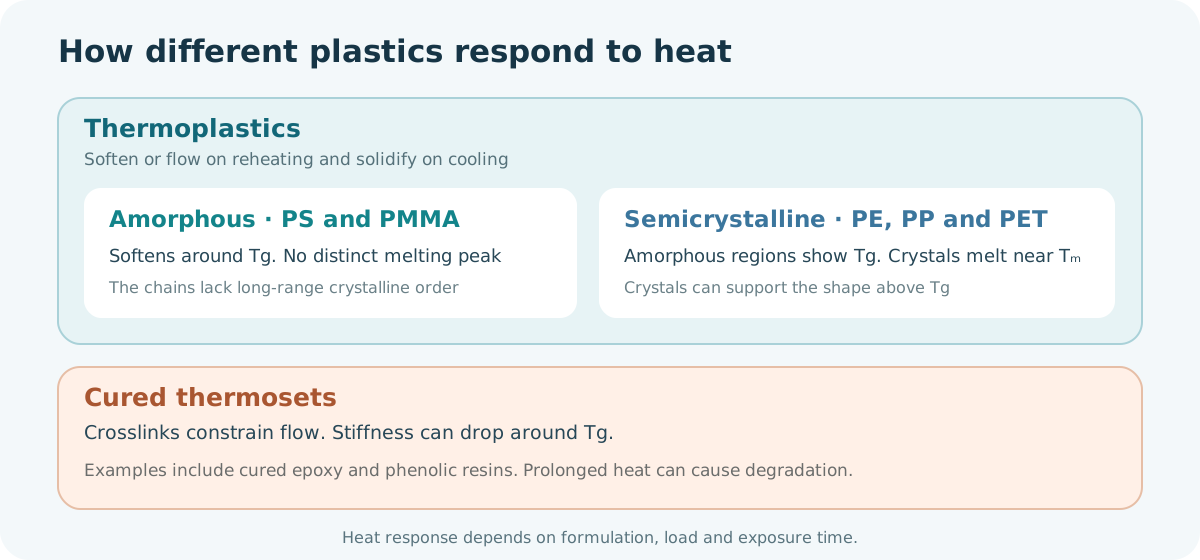
Thermoplastics can soften or flow when reheated and solidify when cooled. Cured thermosets retain a network of crosslinked chains. The terms *amorphous* and *semicrystalline* describe how chains are arranged in the solid, which is a separate distinction.
↔ 表が見切れている場合は、左右にスクロールしてご覧ください。↔ Scroll the table horizontally to see any hidden columns.
| Material | Behaviour on heating | Thermal transitions | Examples |
|---|---|---|---|
| Amorphous thermoplastic | Softens around Tg and can flow at higher temperature | Glass transition | PS, PMMA |
| Semicrystalline thermoplastic | Crystalline regions can support the shape above Tg until they melt | Tg of the amorphous regions and Tₘ of the crystalline regions | Polyethylene (PE), PP, PET |
| Cured thermoset | Stiffness can drop on heating. The network constrains flow | Can show a Tg. Further heating can lead to degradation | Cured epoxy, phenolic resin |
A cured epoxy part can deflect above its Tg while its crosslinked network remains intact. Repeated processing can also degrade a thermoplastic, so the ability to reshape it tells you only part of its heat history. NIST comparison of thermoplastics and thermosets
What changes when a plastic reaches its glass transition?
Around Tg, segments of chains in the amorphous regions begin to move more readily on the timescale of the test. An amorphous thermoplastic typically becomes easier to deform under load. In a semicrystalline plastic, the crystals can continue to provide support. How much a part softens depends on its crystalline content, fillers, thickness and load.
Why do plastics warp below their melting points?
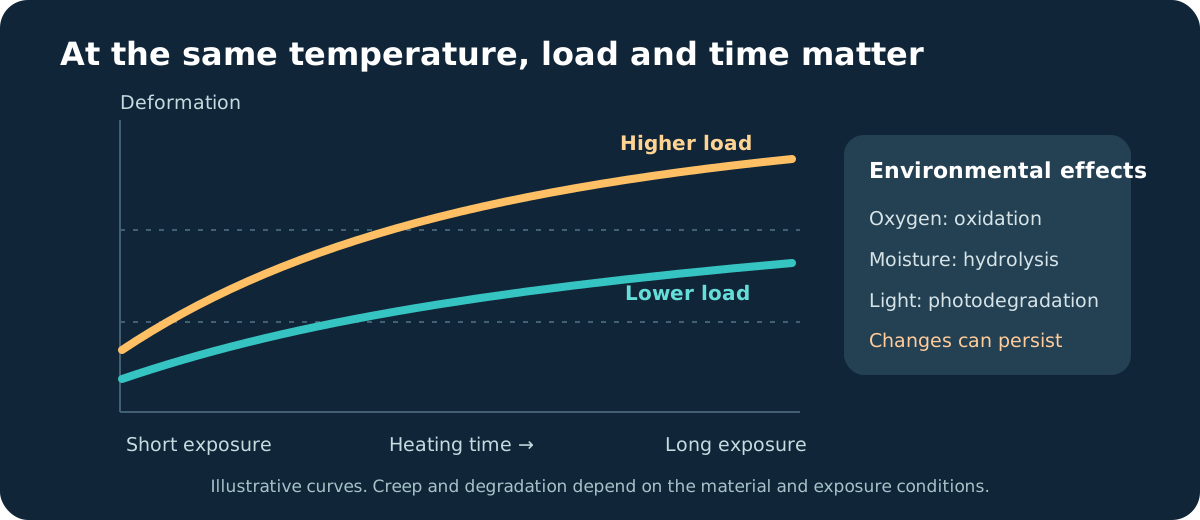
Heating can relax molecular orientation and residual stresses left by moulding or rapid cooling. If one side heats faster, uneven thermal expansion can also cause warping. Under a sustained load, a part can continue to deform over time through creep. These effects can cause warping, shrinkage or bending even below Tg or Tₘ.
In an HDT test, the specimen is heated under a specified bending load until it reaches a defined deflection. The Vicat softening temperature (VST) is the temperature at which a loaded indenter reaches a specified depth as the specimen is heated. Compare data using the same test method, load and heating rate. ISO 75-1, deflection under load · ISO 306, Vicat softening temperature
↔ 表が見切れている場合は、左右にスクロールしてご覧ください。↔ Scroll the table horizontally to see any hidden columns.
| Temperature | What it describes | How to use it |
|---|---|---|
| Glass transition temperature, Tg | Increased chain mobility in amorphous regions | Explain changes in stiffness and softening |
| Melting temperature, Tₘ | A representative temperature for melting of polymer crystals | Compare semicrystalline resins or narrow down material candidates |
| Heat deflection temperature, HDT | A specified deflection in a bending test | Compare behaviour under matching test conditions |
| Vicat softening temperature, VST | A specified penetration depth in an indentation test | Compare thermoplastic softening under matching test conditions |
| Heat-resistance rating on the product | A rating for the finished product under its stated conditions | Read with the manufacturer’s use instructions, including any microwave guidance |
One PP grade, two deflection temperatures. LyondellBasell lists a melting temperature of 160 °C for grade 3486-01. Its unannealed specimen reaches the specified deflection at 100 °C under about 0.45 MPa (66 psi) of bending stress and at 55 °C under about 1.82 MPa (264 psi). The higher test stress brings the specimen to the deflection criterion at a lower temperature. For a long-term service limit, evaluate the actual part under its expected load and exposure time. LyondellBasell 3486-01 grade data · ISO 75-1
↔ 表が見切れている場合は、左右にスクロールしてご覧ください。↔ Scroll the table horizontally to see any hidden columns.
| Situation | Possible cause | What to check |
|---|---|---|
| A thin case warps in a hot car | Softening, stress relaxation or uneven heating | Surface temperature, mounting, thickness and exposure time |
| A container shrinks after contact with a hot drink | Orientation from stretching or moulding relaxes | Intended filling temperature, contact time and moulding conditions |
| A container or lid deforms in a microwave | Heat from the contents softens part of the container | Instructions for the body and lid, temperature ratings and heating conditions |
| A part bends near hot equipment | Softening and creep under load | Continuous service conditions, load, support and HDT |
| A part yellows or cracks after prolonged use | Degradation promoted by heat, oxygen or light | Service and storage history and differences between the surface and interior |
For microwave use, check the instructions for the finished product, including whether the lid can stay on and any restrictions on the contents or heating time. The same resin name can appear on products with different instructions. Japan Consumer Affairs Agency guidance for plastic kitchenware
Thermal degradation changes the polymer itself
Chain scission can lower molecular weight and reduce strength or toughness. Oxidation can contribute to discolouration and surface cracks. Some materials crosslink further and become harder or more brittle. In susceptible polymers, heat and moisture can accelerate hydrolysis. The mechanism depends on the polymer and its environment. NIST report on polymer degradation
A part can retain a new shape after softening and cooling even when the polymer chemistry remains intact. Compare unused and used parts, check the surface and interior, and record mass, strength or colour before and after exposure to help identify the cause.
Using melt mass-flow rate (MFR) to investigate degradation. Compare the same grade under matching test temperature, load, drying and heating time. A study of PP reprocessing reported a rise in MFR alongside chain scission. Crosslinking can make flow more difficult. If the MFR changes, check appearance and strength, and investigate molecular weight or chemical structure if needed. ISO 1133-2 · PP recycling study
Using Tg and melting point to identify a material
Grades within the same polymer family can have different molecular weights, crystallinity, additives, moisture contents and thermal histories. When comparing DSC data, report which point you used, such as the glass-transition midpoint or the melting peak. The lookup tool can help shortlist candidate materials. If the concern is warping or failure in service, follow up with the grade’s data sheet, the applicable service conditions and tests on the actual geometry. Polymer Tg and melting point lookup
For more on measured transitions and material identification, read Polymer identification from Tg and Tₘ (Japanese) and Plastics identification using DSC and Fourier transform infrared spectroscopy (FT-IR) (Japanese).
How to investigate a deformed plastic part
- Describe the change. Record warping, shrinkage, deflection, apparent melting, discolouration or cracking.
- Record temperature, time and forces. Include surface temperature, load, support and the number of heating cycles.
- Identify candidate materials. Use the Tg and Tₘ lookup and, as needed, DSC and FT-IR measurements.
- Choose properties that match the application. Check HDT, modulus, creep and ageing data alongside Tg and Tₘ.
- Test the part under comparable conditions. Match the grade, composition, thickness, load and exposure time. Check both shape and appearance.