
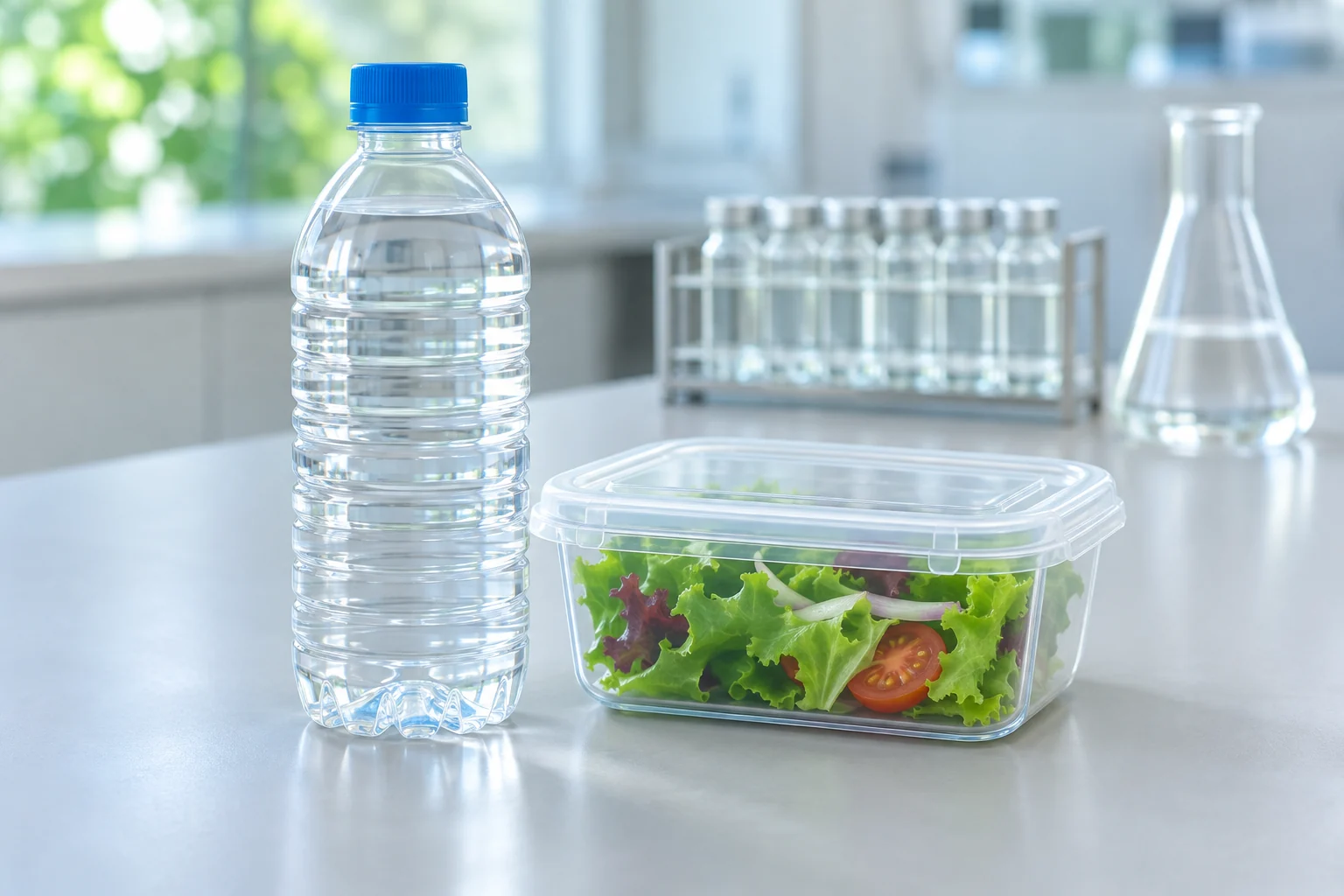
When you drink from a plastic bottle or reheat leftovers in a storage container, small amounts of substances can move from the container into the food or drink. Antimony from a catalyst used to make some water bottles is one example. What moves and how much depends on the material, the food, the temperature and the contact time.
When a headline says a substance was detected, ask what was measured, where it was found, under what conditions and against which limit. Japan’s food contact rules offer a practical example of how to read these results.
What can migrate from different containers?
Plastics are made chiefly of polymers, which are long chains of repeating units. Manufacturers may use additives to adjust properties and catalysts to aid reactions. Small molecules left over from manufacture or formed during processing can also migrate. Check the material of each food contact part, such as the bottle wall, cap, lid seal and inside coating of a can.
↔ 表が見切れている場合は、左右にスクロールしてご覧ください。↔ Scroll the table horizontally to see any hidden columns.
| Container or part | Examples of what laboratories test |
|---|---|
| Plastic water bottle body | The Japanese rules for polyethylene terephthalate (PET) specify migration tests for antimony and germanium. These elements may originate from catalysts used to make the resin. |
| Polypropylene (PP) storage box | A test liquid is chosen for the intended food. One test weighs the residue left after that liquid is evaporated. |
| Silicone rubber bakeware, containers or lids | Japanese rules for rubber articles include migration tests for phenol, formaldehyde, zinc and evaporation residue. Researchers have also examined the migration of small siloxane molecules. |
| Expanded polystyrene foam trays and cups | A material test measures residual styrene and related compounds in the resin. A migration test measures properties of the liquid after contact, such as its evaporation residue. |
| Ceramic plates and cups | Tests assess how much lead and cadmium can migrate from the food contact surface. Limits depend on the shape, volume and intended use of the article. |
PET bottles can be made with different catalysts, and the cap may be made of a different material from the bottle. Researchers have also measured the migration of acetaldehyde, which can form during processing, into bottled drinks. Japan Consumer Affairs Agency (CAA), material specifications in Japanese · Study of migration from PET bottles
How does a migration test work?
A laboratory analyses a liquid after it has been in contact with the container. The rules specify food simulants to represent different types of food, for example water, dilute acetic acid, aqueous ethanol or heptane. The choice depends on the material, its intended use and the test.
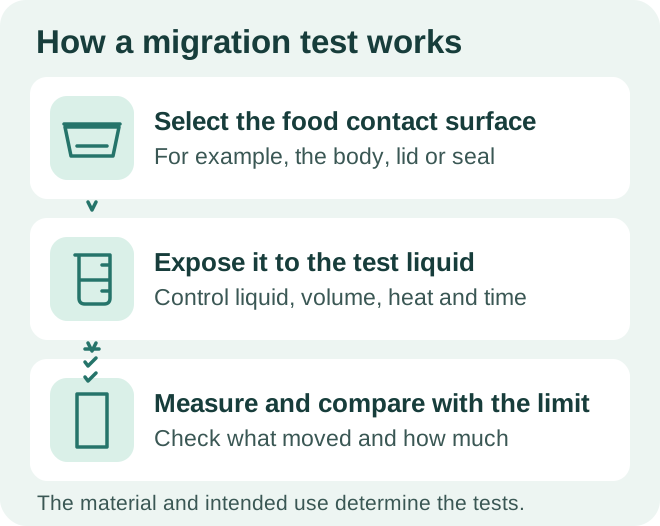
Water and fatty food can pick up different substances from the same material. Changing the contact time or temperature can change the amount that migrates. The same amount of a substance also gives a higher concentration in less liquid. Specifying the liquid, contact area, volume, time and temperature gives laboratories a common basis for comparing results. CAA, revised specifications and test conditions in Japanese
How do Japan’s food contact rules work?
Under Japan’s Food Sanitation Act, a result can describe how much of a substance is in the material or how much moves into a test liquid. A positive list also governs the use of raw materials for covered synthetic resins.
↔ 表が見切れている場合は、左右にスクロールしてご覧ください。↔ Scroll the table horizontally to see any hidden columns.
| Check | What it covers | How to read it |
|---|---|---|
| Positive list | Permitted base polymers and additives for covered synthetic resins, with conditions of use | Check the materials and formulation against the applicable entries. |
| Material specification | The content of a specified substance in the material | The result may be reported in micrograms per gram of material. |
| Migration specification | The amount transferred to a test liquid under specified conditions | The result may be reported per millilitre of liquid or per square centimetre of contact area. |
Some migration tests measure a particular substance. Others weigh the residue left after the liquid is evaporated under specified conditions. To identify what is in that residue or measure a specific substance, a laboratory needs a suitable targeted analysis. An amendment effective in June 2026 introduced an overall migration specification for synthetic resin articles without individual specifications. Transitional provisions apply, so check which rules cover the product when ordering a test. CAA positive list in Japanese · Revised specifications in Japanese · Updated transitional provisions in Japanese
A PET bottle example: detection and compliance
For articles made chiefly of PET, Japan specifies 4% acetic acid as the food simulant for antimony and germanium. The limits in the test liquid are 0.05 µg/mL for antimony and 0.1 µg/mL for germanium. A prescribed example for synthetic resin articles intended for use at up to 100 °C uses contact at 60 °C for 30 minutes with this simulant. CAA test conditions and material specifications in Japanese
If a hypothetical test under the prescribed conditions gave 0.010 µg/mL of antimony, the laboratory would have detected antimony at one fifth of the limit for that test. Assessing the product requires checking all applicable criteria.
The limit in the acetic acid test liquid and any limit for the drink itself apply to different samples. When comparing results, check what was measured, which method was used and whether the units match. When reading “not detected”, check the detection limit. To assess potential health effects, the substance’s properties and the amount consumed also matter. CAA overview of food safety standards in Japanese
What can migrate from silicone containers and bakeware?
Flexible silicone rubber moulds and collapsible containers can contain low-molecular-weight siloxanes, short chains or rings related to the silicone polymer. Studies of silicone bakeware have measured migration into food, with results varying with the food, including its fat content. The amount depends on the product and cooking conditions. Study of siloxane migration from silicone bakeware
Japan treats silicone rubber bakeware and containers under its specifications for rubber food contact articles. Cadmium and lead are examples of substances measured in the material itself. Phenol, zinc and evaporation residue are examples of migration test items. To quantify individual siloxanes in food, a laboratory needs a method that targets those substances. CAA material specifications, Section III D, in Japanese
How do polystyrene foam trays and cups differ?
Expanded polystyrene has a cellular structure that makes it light. It is used in food trays and some instant noodle cups. Researchers have studied the migration of styrene left over from manufacturing, along with dimers and trimers, compounds made of two or three styrene units. The amounts depend on the container and the food or test liquid in contact with it. Migration study of commercially available polystyrene food containers
Japan’s material specification for polystyrene covers five compounds including styrene. For expanded polystyrene intended to be used with boiling water, the sum is limited to 2 mg per gram of material, and styrene and ethylbenzene are each limited to 1 mg per gram. A separate migration test examines the liquid after contact. CAA material specifications, Section III D, in Japanese
What should you look for on the label?
- Microwaving leftovers. Check the container instructions for microwave use and see whether the lid needs to be removed or the vent opened.
- Heating a silicone mould or lid. Check the temperature rating and the heating methods listed for each part. CAA guide to labelling rubber kitchenware in Japanese
- Warming food on a foam tray. Check for instructions that allow microwave use. If you cannot verify them, transfer the food to a microwave-safe plate. A noodle cup intended for boiling water has its own preparation instructions. Japanese Polystyrene Foam Sheet Industry Association, use instructions in Japanese
- Pouring boiling water into a bottle. Choose one specifically rated for that use. For carrying water every day, choose a washable reusable bottle or flask and follow its cleaning instructions.
Heat resistance tells you how to use a product within its rated conditions. For the material science behind softening and deformation, see the companion article. Why does plastic deform when heated?
Where do PAHs in food come from?
Polycyclic aromatic hydrocarbons (PAHs) can form during combustion or thermal decomposition. In smoked or flame-grilled food, they can form during cooking or reach the food from the smoke. Environmental contamination can also contribute. A PAH measurement in packaged smoked food provides a concentration for the sampled food. To find its source, investigators can examine the ingredients, processing steps and contact with packaging. Japan Ministry of Agriculture, Forestry and Fisheries, PAH overview in Japanese
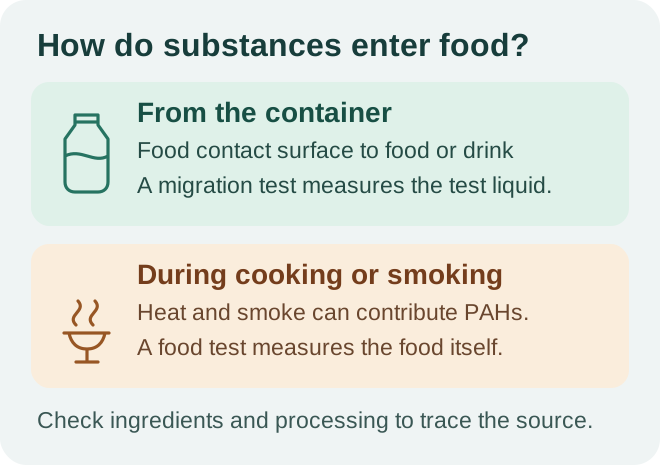
For instance, the European Union (EU) sets maximum levels for benzo[a]pyrene and the sum of four specified PAHs in foods such as smoked meat. These limits apply to the concentration measured in food. A container migration test answers a different question about the transfer of substances under defined conditions. EU regulation on contaminants in food
To investigate packaging as a source, compare food before and after packaging and test migration from the food contact surface. The related PAHs guide compares how food, water and rubber products are tested. PAH regulations and analytical methods (Japanese)